
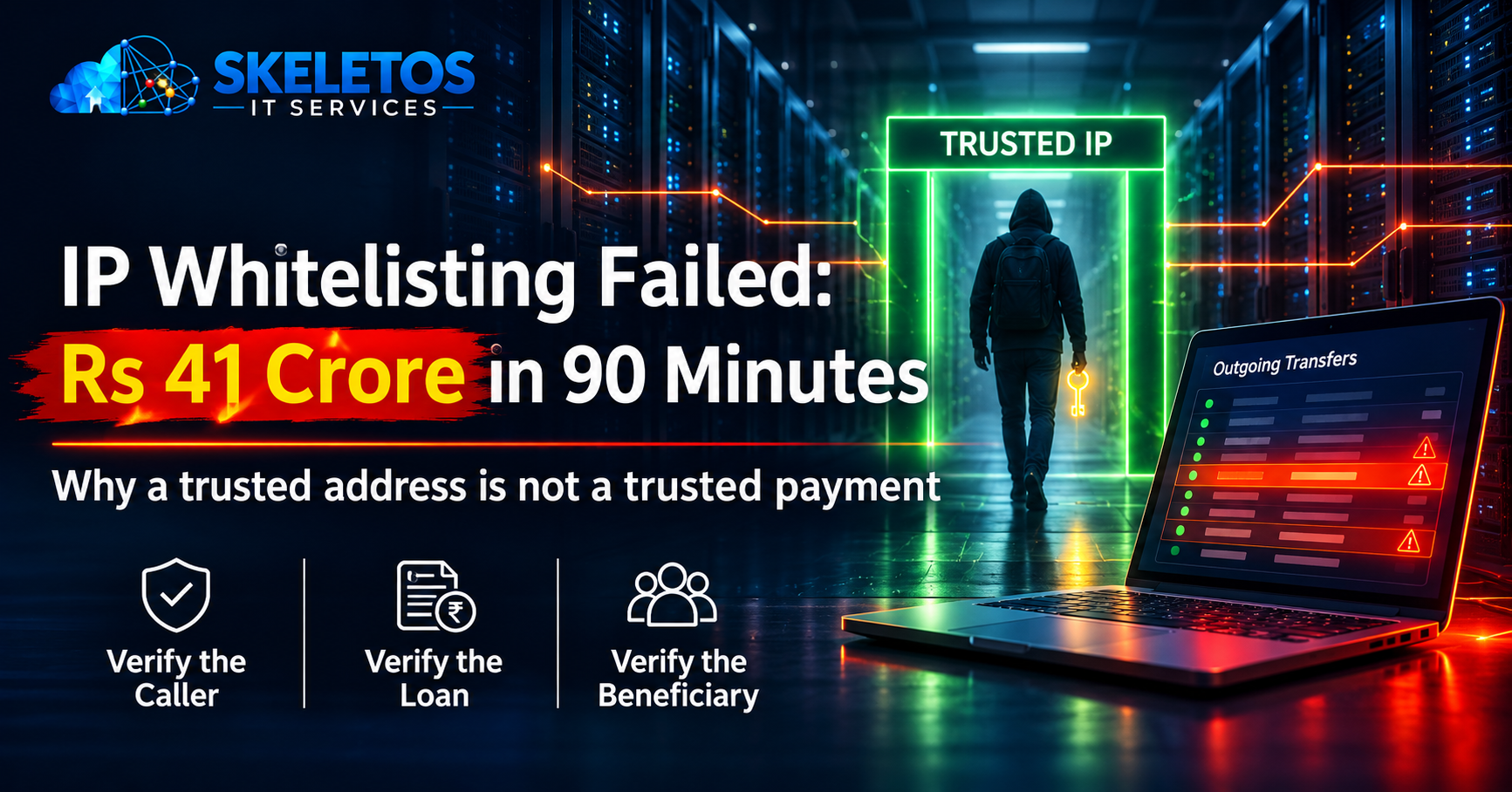
At 1:30 pm on Monday, 16 November, a South Delhi NBFC started losing money.
By 3 pm, about Rs 41.27 crore had left in 96 unauthorised transfers to 96 different accounts, according to the police complaint reported by Newsgram. However, nobody at the company noticed in real time. Instead, they found out that evening, while reviewing their own records.
Later, Delhi Police traced the IP addresses used in the fraud to Hong Kong. Taala band tha. Chaabi chor ke haath mein thi.
We do not know yet whether this exact NBFC fell to the pattern police describe across 12 other cases. Still, that pattern is the lesson, and it is more uncomfortable than a stolen password.
Why does IP whitelisting fail to stop NBFC loan-disbursal fraud? Because an IP address proves where a request came from. It does not prove who sent it, or whether the payment is real. Instead, attackers rent servers on the same public cloud platforms that NBFCs trust, send disbursal commands from those addresses, and swap the borrower’s bank account for a mule account. Therefore, the fix is to verify the caller, the loan record, and the beneficiary on every single payout.
Why This Matters for Indian Companies
Delhi Police say 12 NBFCs in Delhi-NCR lost more than Rs 65 crore in three months. Meanwhile, officers arrested 20 people, all linked to creating or procuring mule accounts. About Rs 18 crore was seized before it left those accounts as cash or crypto, according to MediaNama.
Nationally, the count is larger because MediaNama reports more than 150 FIRs filed by NBFCs across India. Some outlets put total losses near Rs 300 crore, but RBI has not confirmed that figure, so treat it as an estimate.
The regulator has also moved. A confidential RBI advisory dated 3 November, reported by The Head and The Tale, reportedly requires NBFCs that use bank APIs to pass a security audit by a CERT-In-empanelled auditor. New clients must finish it before onboarding. Meanwhile, existing clients have until 3 February 2027.
In addition, CyberNX reports that existing API integrations need at least one safeguard, either beneficiary whitelisting or maker-checker approval, by 3 December 2026. That date is days away. However, the advisory is not public, so confirm both dates with your bank in writing.
If you read our earlier post on how 700 transfers drained $2 million from two Mumbai NBFCs, this is the next chapter. That post covered stolen credentials. This one covers something harder to see, because the attackers look exactly like you.
What Went Wrong: The Attack Chain
Here is the sequence Delhi Police describe. So read it as a checklist of decisions your own team may have made.
- A flaw in the front end. First, police say attackers use malware against the front end of NBFC applications, exploiting software flaws that smaller firms leave unpatched. Our post on PHP2Shell and Node2Shell shows how a single unpatched server becomes a foothold, because attackers then move inward.
- Seven to eight days of silence. Next, the malware stays undetected for seven to eight days. During that time, it reads the list of loans that are approved but not yet disbursed.
- Learning your commands. Then comes the learning phase. One officer put it plainly: “The malware helps the fraudster identify the set of commands required to be given to the system for the disbursement of loans.”
- Renting a trusted address. Most NBFCs host on public cloud and whitelist that cloud’s outbound IPs at the bank. Because anyone can open an account on those platforms, attackers send disbursal commands from the same trusted ranges. Moneylife’s summary of the CERT-In advisory adds that attackers can also route requests through shared IPs used by content-acceleration services and app-store review systems.
- Swapping the beneficiary. After that, the commands replace the borrower’s account details with a mule account.
- Instant approval, instant exit. Finally, the bank sees a valid command from a trusted address and approves it. The money then hops through mule accounts into cash or crypto.
Notice what never happened. Nobody guessed a password, and nobody phished a customer. Instead, the attackers inherited your trust.
Why IP Whitelisting Fails
IP allow-listing, also called whitelisting, is a network control that accepts requests only from pre-approved IP addresses. It answers one question: is this request coming from a place we trust? However, it does not answer whether the caller is who they claim to be, or whether the payment itself is legitimate.
That gap is where the money went. For example, the table below shows what each control actually proves, and what an attacker with malware on your server can still do.
| Control | What it proves | What the attacker can still do |
|---|---|---|
| IP allow-listing | The request came from a trusted address | Sent from a rented address in the same cloud range, or from your own compromised server |
| API key or static token | The caller holds a secret | Read the secret from a config file or memory |
| mTLS client certificate in an HSM | The caller holds a key that cannot be copied out | Ask for signatures, but cannot steal the key |
| Ledger-bound, signed payout | This exact payout matches a sanctioned loan and a verified beneficiary | Nothing useful, because a changed beneficiary fails the check |
| Maker-checker with cooling period | A second person approved any beneficiary change | Cannot approve their own change |
How It Could Have Been Stopped
No single control stops this. Because attackers need the early steps to work, the defence is to break several of them. So here are the layers, in the order we would build them.
Prove who is calling
First, replace static tokens and IP trust with mutual TLS and signed requests. Every disbursal call carries a short-lived signature over the payload, a timestamp, and a one-time nonce. The signing key lives in an HSM or managed KMS, so malware on the web server cannot copy it out.
Because the request is signed, a replay from a rented cloud address fails. As a result, the address no longer matters, which is exactly the point.
Prove the payment is real
Next, bind every payout to the loan ledger. The disbursal service reads the sanctioned loan, and refuses anything that does not match. For example, here is the logic in plain code:
def approve_disbursal(req, ledger):
    loan = ledger.get(req.loan_id)
    assert loan.status == "SANCTIONED_UNDISBURSED"
    assert req.amount == loan.sanctioned_amount
    assert req.beneficiary_hash == loan.verified_beneficiary_hash  # set at sanction, read-only here
    assert verify_signature(req, max_age_s=30, nonce_unused=True)
    assert within_limits(req.amount, loan.product, today_total())
    return release_to_bank(req)
The key design rule: the web tier can request a disbursal, but it can never write to the ledger or change the verified beneficiary. So when malware sits on the web tier, it can ask, yet every swap attempt fails the check.
Prove the beneficiary
Then freeze beneficiary details at sanction. Any later change needs a second approver, a penny-drop name match against the borrower’s KYC name, and a cooling period before money moves. This is the maker-checker control the RBI advisory reportedly names, and it directly breaks step 5 of the chain.
Close the path to the disbursal service
Finally, attackers still need a route from a compromised front end or a stray device to your payout systems. So segment the disbursal service from the public web tier, restrict its outbound traffic to the bank, and control what can reach it.
This is where EasyNAC supports the design. It identifies every device on your network the moment it connects, and it lets you allow only registered devices to reach the segment that holds disbursal servers and admin consoles. It will not patch a front-end flaw or validate an API call. Instead, it shuts the lateral path from an unknown or compromised machine, which we cover in our post on the missing NAC layer at NBFCs.
The first four layers are software design, and that is where our software engineering team works with lenders: building disbursal services so that a compromised web tier is powerless by construction, not by luck.
What changes when this is in place? A rented cloud address becomes useless, and a swapped beneficiary fails at the ledger. As a result, your finance head sees a beneficiary-change alert before money moves, instead of a statement discrepancy at 7 pm.
What Every CTO Should Do
You can start today. However, the order matters, because RBI’s reported dates are close.
Before 3 December
- Ask your bank which safeguard it will enforce on your API. The choice is beneficiary whitelisting or maker-checker. Then get the answer in writing, and switch on both if the bank supports them.
- Bind every payout to a sanctioned loan record. Also reject any disbursal where the loan ID, amount or beneficiary hash does not match the ledger.
- Freeze beneficiary edits after sanction. Require a second approver, a penny-drop name match and a cooling period for any change.
- Alert on the three signals attackers cannot hide. Watch for a beneficiary change between sanction and disbursal, a burst of payouts in a minute, and any disbursal outside business hours. Also reconcile against bank statements hourly, and review weekends first.
Before 3 February 2027
- Book a CERT-In-empanelled auditor now. Auditors fill up near deadlines, so scope the API gateway, secrets, the disbursal service, and logging.
- Replace static tokens with mTLS and short-lived signed requests. Then keep keys in an HSM or managed KMS and rotate them on a schedule.
- Separate the web tier from the disbursal service. Instead of trusting the web tier, give it no write access to the ledger, allow-list its outbound traffic, and put NAC on the management segment.
- Hunt for seven to eight days. First, run file-integrity monitoring and EDR on application servers, look for web shells, patch middleware, and keep centralised logs for at least 180 days.
- Rehearse the six-hour clock. CERT-In requires incident reports within six hours, and NBFCs also report to RBI through the DAKSH portal. Moreover, under the DPDP Act, failing to keep reasonable security safeguards can carry a penalty of up to Rs 250 crore. Therefore, use our incident response guide to run a tabletop this month.
The Bigger Picture
Step back from one South Delhi NBFC, because over the last three months attackers have moved from phishing customers to editing lenders’ own records. The same shift shows up in the RBI risk and assurance framework, which asks regulated entities to prove controls work in practice, not just on paper.
The pattern will not stay with NBFCs, since banks, payment aggregators, and any lender with an API that moves money face the same logic. Attackers no longer break trust. Instead, they borrow it, and trust built on addresses and static keys is cheap to borrow.
Final Thought
A whitelist is a list of who you trust. The attackers did not break it, but they joined it.
So stop asking which addresses may call your bank. Start asking which payments your bank should refuse even when the address is right.
At Skeletos IT Services, we help Indian banks, NBFCs, and microfinance institutions deploy EasyNAC, a plug-and-protect Network Access Control solution that gives IT teams real-time visibility into every device on their network without any switch changes or network reconfiguration. If you want to understand what is actually connected to your network right now, we can show you in a 30-minute demo.