A business owner, Founder of a mid-size company from our ‘Business Community’, a sharp guy, has been in the industry for 15 years — called me a few days ago, sounding genuinely frustrated.
“Pramood,” he said, “we are paying for 6 SaaS tools. Half of them overlap. Every single one of them raised prices this year. And I still do not have full control over where our data actually lives.”
I hear the same version of this almost every week now.
And every time, the same question follows: “Should we just move off SaaS completely?”
My answer: NO… SaaS is not dead. But something has definitely changed. And if you are a CTO, IT head, or business owner in India signing SaaS renewals right now without asking hard questions, you are probably leaving a lot of money on the table. And taking on more compliance risk than you realise.
Let me explain what is actually happening and what Indian businesses should do about it.
First — what changed?
For a long time, SaaS was the obvious answer. No servers to manage, no upfront cost, just pay monthly and get started. For small companies, especially, it was a genuinely good deal.
That deal has quietly gotten worse.
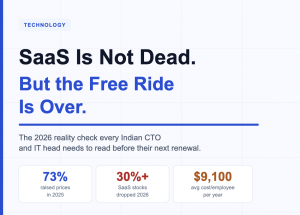
According to research tracking SaaS pricing trends in 2025–26, 73% of SaaS companies raised their prices in 2025. The average increase was 14.2%. SaaS inflation is running at 12.2% — nearly five times the G7 average. The cost per employee for SaaS tools hit $9,100 per year, up 15% in just two years.
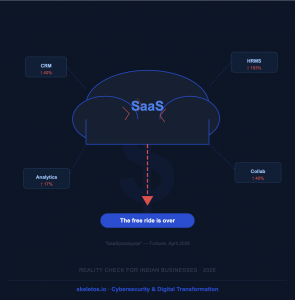
Here is what that looks like in practice. A Google Workspace — up 40% in two years. Adobe Creative Cloud — jumped 17-18%, then cut the AI credits it had promised from 500 to 25. Atlassian Enterprise — customers reporting increases of up to 153%. Slack — reportedly asked a non-profit to pay $200,000 per year, up from $5,000.
And on the stock market, something called the “SaaSpocalypse” is playing out in real time.
What the market is signalling right now:According to Fortune’s April 2026 report, shares in Salesforce, SAP, Workday, and ServiceNow fell 30% or more in early 2026 — far worse than the broader market. Investors are not just reacting to one bad quarter. They are questioning whether the per-seat SaaS model itself has a fundamental structural problem. |
But here is the honest part — SaaS is not going away
Before I get into what is changing, I want to be straight with you: SaaS is not dying.
The global SaaS market was valued at roughly $409 billion in 2025 and is still forecast to grow significantly through 2035. Enterprise cloud spending is going up. Most companies are not ripping out their SaaS stack and going back to on-premise servers.
What is changing is the mindset. The era of signing up for SaaS tools without asking hard questions is over. CFOs are now doing the maths. CTOs are auditing their stacks. IT heads are being asked to justify every renewal.
That is healthy. That is what should have been happening all along.
The real shift:Companies are not moving away from SaaS. They are getting smarter about which tools deserve to be on SaaS, which should be self-hosted, and which an AI agent will probably replace in two years anyway. “SaaS for everything” is over. “SaaS where it makes sense” is the new standard. |
Three things are pushing Indian companies especially hard
There are global SaaS pressures, and then there are the India-specific ones. Both are hitting at the same time.
- The rupee makes the maths worse. When a US SaaS company raises prices 15% in dollar terms, and the rupee has also weakened, Indian companies absorb a double hit. Many finance teams are only now running these numbers properly — and being genuinely shocked by what they find. ₹1.5 lakh per employee per year in SaaS costs is not unusual for mid-size companies anymore. Most have never audited this figure.
- Compliance is getting stricter. Under CERT-In’s 2022 directions, companies must maintain system logs, control data access, and report incidents within 6 hours. When your data is in a foreign vendor’s multi-tenant cloud, on servers you do not control, that becomes a real compliance question — not just a theoretical one. Regulated sectors like BFSI and payments are feeling this most acutely right now.
- AI is about to break the per-seat model. SaaS pricing assumes a human logs in, uses the tool, and you pay per seat. But AI agents do not have seats. Gartner predicts 35% of point-product SaaS tools will be replaced by AI agents by 2030. If an AI agent can do the same work as five employees without a licence fee, the whole pricing model breaks. Some CTOs I speak to are already building internal tools to replace their most expensive SaaS subscriptions. This is going to accelerate.
What should you actually do — a simple framework
I am not saying go cancel all your SaaS subscriptions tomorrow. That is not the answer. The answer is to be deliberate — probably for the first time — about what you are paying for and why.
Here is the framework I walk through with clients:
Keep on SaaS — tools where the vendor’s network, constant updates, or specialised compliance genuinely justifies the cost. Security tools, communication platforms with large user bases, and anything where the vendor’s infrastructure outperforms what you could realistically build internally.
Consider self-hosting — CRM, project management, document storage, and internal communication. All of these have excellent, mature open-source alternatives in 2026. The cost difference is often dramatic, and India has the engineering talent to run them well. Self-hosting interest tripled in the first five months of 2025 — this is not a fringe movement anymore.
Evaluate for AI replacement — any point-solution SaaS that does one narrow, repetitive task. Ask honestly: could an AI agent handle this without a monthly licence? If yes, stop renewing and build or configure the replacement.
Audit first, everything else second — the average organisation uses 300+ SaaS apps. Most IT heads I speak to in India cannot name more than 40% of theirs. Shadow SaaS — tools employees sign up for without IT knowing — is a security and compliance risk as much as a cost problem. Do the audit before making any other decisions.
One thing nobody says loudly enough — the security angle
Here is the part that matters specifically to what we do at Skeletos IT.
Moving workloads from SaaS to self-hosted does not automatically make you more secure. For many companies, it makes them less secure — at least initially. A SaaS vendor with a large security team and SOC 2 certification is often more secure than a mid-size company’s self-hosted deployment managed by two engineers and no monitoring.
The decision of where to run your software is a business and cost decision. How to secure it — wherever it runs — is a separate, equally important question that has to be answered before you migrate, not after.
If you are reconsidering your SaaS stack, build the security architecture first. Network segmentation, access controls, device visibility, and continuous monitoring. The cloud did not make you secure. Moving away from it will not either — unless security moves with you.
The bottom line
SaaS gave us a lot. Faster deployment. Lower upfront cost. Access to tools that smaller companies could never have built themselves. That value is real, and it has not disappeared.
But the era of signing up for software without asking hard questions — without auditing the cost, without understanding the data sovereignty implications, without a plan for what happens when the vendor raises prices 40% next year — that era is over.
The free ride is over. What comes next is better, actually — it just requires more thought.
And the companies that think carefully about their software stack in 2026 are going to come out with lower costs, better data control, and a security posture that they actually own. That is a good outcome.
Sources & Further Reading
→ Why should you invest in custom Software Development
→ The Great SaaS Exodus — Elest.io (2026)
→ SaaSpocalypse: CIOs Take a Harder Line — Fortune (April 2026)
→ Will AI Disrupt the SaaS Business Model? — Intellectia.ai (2026)
→ Why Enterprises Are Moving to Self-Hosted — IOMETE (2026)
→ Global SaaS Market Size & Forecast — Cervicorn Insights (2026)