Somewhere in a factory in Tamil Nadu, assemblers are building iPhones.
The process is precise, regulated, documented to an extraordinary degree. Quality inspection standards for circuit board components. Material specifications. Assembly procedures. Standard operating procedures for every machine on the floor. This documentation exists because Apple requires it. Because building one-third of the world’s most valuable consumer device requires a level of process discipline that leaves nothing undocumented.
That documentation also exists on file servers.
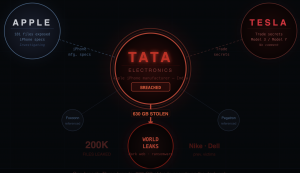
On June 12, 2026, a ransomware group called World Leaks posted 204,341 files totalling 630.4 gigabytes on their dark web leak site, claiming the data came from Tata Electronics. The dataset reportedly includes Apple and Tesla schematics, technical and mechanical drawings, full passport scans of employees including foreign nationals, manufacturing records, internal emails, event logs spanning several years, and documents marked as “proprietary and confidential.” Z CybersecurityShardul Amarchand Mangaldas
On June 22, 2026, Tata Electronics confirmed the breach to BleepingComputer: “A few weeks ago, Tata Electronics identified a cybersecurity incident on some of our systems. Our response protocols were deployed immediately, and the incident has had no impact on our operations across businesses, which remain unaffected.” Vistainfosec
Operations unaffected. Systems restored. Business continues.
What does not continue is the confidentiality of Apple’s manufacturing specifications, Tesla’s engineering drawings, and the passport details of every foreign national who ever worked at a Tata Electronics facility.
This was not an attack on Apple. It was not an attack on Tesla. It was an attack on the company that builds their products. And in the modern supply chain, that distinction matters far less than it used to.
What Was Actually Stolen
The alleged 204,341-file cache reportedly contains Apple and Tesla schematics, technical and mechanical drawings, full passport scans, and more.
A search for “Apple” within the World Leaks database returned 181 files and folders, several labelled “com.apple.factorydata” and referencing “material specification.” Among the files was a 52-page document bearing Apple’s proprietary markings, purportedly detailing quality inspection standards for iPhone circuit board components. Some files explicitly carried the footer: “This document contains proprietary and confidential information of Apple Inc.” Shardul Amarchand Mangaldas
On the Tesla side, researchers identified engineering drawings marked “TRADE SECRET” and associated with Project Highland, Tesla’s internal codename for the revamped Model 3 sedan. Additional files reference a charge-port controller used in the Model Y programme. Tesla file footers state the contents were “deemed confidential, proprietary, and a trade secret of Tesla Inc.” Mondaq
Other files Cybernews reviewed ranged from Tata Electronics energy bills and factory licences to a folder titled “War Room documents,” folders labelled “Equipment Data,” “IATF Audit Documents,” “Maintenance Engineer reports,” and dozens of Standard Operating Procedure spreadsheets covering machine setup, inspection, and manufacturing processes. Screenshots also show copies of several employee passports, while researchers identified employee emails and other sensitive operational data, including cryptographic certificates, key files, and event logs spanning several years.
The cryptographic certificates and key files are, arguably, the most dangerous category in this list. They are not just historical data. They are potentially active credentials that could give an attacker continued access or the ability to impersonate Tata Electronics systems long after the initial breach was contained.
Who World Leaks Is
World Leaks was launched in early 2025 and is widely believed to be a rebrand of the notorious Hunter’s International ransomware cartel. Z Cybersecurity
Other high-profile World Leaks victims include computer manufacturer Dell, which confirmed a breach in July 2025, and sportswear giant Nike, which launched an investigation after a claimed theft of 1.4 TB of files in January 2026. Vistainfosec
The pattern across all three victims is consistent. World Leaks does not announce attacks the way traditional ransomware groups do, encrypting systems first and then demanding payment. They exfiltrate silently over an extended period. They accumulate data. Then they post publicly and demand payment to prevent further release. This is double extortion evolved: by the time the victim knows they have a problem, the data is already gone, and the attacker holds all the leverage.
Tata Electronics reportedly received a ransom demand linked to the cyberattack, though neither the amount nor the status of any negotiations has been disclosed.
The exfiltration timeline in this case suggests the attacker had access for a significant period before anyone detected it. The leaked dataset contains documents dated as late as May 2026 and event logs spanning several years. The breach was confirmed as having been identified “a few weeks” before the June 22 public statement, which places discovery in early to mid-June at the earliest. The data posted on June 12 was already assembled and ready to publish. The access itself almost certainly predates that posting by weeks or months. Z Cybersecurity
This is the pattern that should concern every manufacturing CTO. The attacker was inside long enough to map the file system, identify the most valuable data categories, and exfiltrate 630 GB without triggering an alert sufficient to stop them. The breach response was activated after the damage was done, not before.
Why Indian Manufacturers Are the Ideal Target
This incident did not happen because Tata Electronics was careless. It happened because of where Tata Electronics sits in the global technology supply chain.
Tata currently manufactures approximately one-third of Apple’s iPhone production in India, with Foxconn accounting for the remainder. That position makes Tata Electronics one of the most strategically valuable nodes in one of the world’s most tightly guarded technology supply chains.
It also makes them a single point of access to intellectual property that Apple, Tesla, and others have spent decades and billions developing.
This is the specific logic that ransomware groups targeting supply chain manufacturers have understood and that their victims often have not. The OEM, whether Apple or Tesla, has enterprise-grade security operations, a dedicated CISO, a large security team, and mature incident detection capability. Their Tier-1 supplier has a smaller IT team, a fraction of the security budget, and the same IP on its servers.
World Leaks’ ability to exfiltrate over 630 GB of highly sensitive OEM data, including design specifications, manufacturing standards, and employee records, signals a dangerous evolution in ransomware tactics targeting high-value supplier networks. India Briefing
This is not the first time Tata Group has faced this kind of incident. A devastating cyberattack on Tata Motors, the parent company of Jaguar Land Rover, forced a complete standstill at the high-end automaker’s UK production facilities last August. Carried out by the Scattered Lapsus Hunters hacker collective, the six-week shutdown was said to have cost JLR an estimated $68 million per week.
Two major Tata Group entities. Two significant cyber incidents within a year. One group. A pattern that demonstrates that targeting Tata-connected entities has become a deliberate strategy for at least one ransomware collective.
For every Indian manufacturer that aspires to, or already holds, a position in global technology supply chains, this pattern is a warning. Your value to a global OEM as a manufacturing partner is exactly what makes you valuable to a ransomware group as a target.
The Supply Chain Trust Problem Nobody Is Addressing
Apple’s quality inspection standards are marked “proprietary and confidential.” Tesla’s engineering drawings are marked “TRADE SECRET.” Both companies take extraordinary measures to protect this IP within their own walls.
When that IP moves to a contract manufacturer’s file server in India, the protection it carries is whatever that manufacturer’s IT infrastructure provides.
This is the supply chain trust problem that the Tata Electronics breach makes impossible to ignore.
Global OEMs like Apple and Tesla perform supplier audits. They inspect manufacturing quality. They review process compliance. Increasingly, they are including cybersecurity as a component of supplier qualification, particularly in automotive supply chains where standards like TISAX already mandate information security management as a condition of engagement with European automotive clients.
But supplier cybersecurity audits cover policies and certifications. They do not give the OEM real-time visibility into whether an attacker is currently sitting inside their supplier’s network, slowly pulling 630 GB of files through an authenticated session that nobody is watching.
This gap will close. Not because OEMs will suddenly trust their suppliers more, but because they will demand demonstrable, continuous security monitoring as a contract requirement. The Tata Electronics breach will accelerate that conversation.
Indian manufacturers who get ahead of this requirement will retain and win contracts. Those who wait to be asked will find themselves on the wrong side of a supplier qualification audit.
What Was Different About This Attack
The breach at Tata Electronics is not a traditional ransomware story because operations were not disrupted. There was no encryption of production systems. No factory floor shutdown. No assembly line halt. Tata Electronics confirmed the breach had not affected its business operations, though it did not disclose what systems were accessed or whether data was actually stolen. Press Information Bureau
This is important because it means the attacker’s goal was not operational disruption. It was data theft and extortion. The most valuable thing in Tata Electronics’ environment was not their manufacturing systems. It was the intellectual property of those systems’ documents.
If the leaked material is ultimately authenticated, the incident could expose closely guarded product designs, manufacturing processes, and supply-chain operations details belonging to some of the world’s largest technology companies.
For an Indian CTO managing manufacturing operations for global OEMs, this reframes the security question entirely. The question is not just: can an attacker shut down our factory? It is: can an attacker sit inside our network for months and copy everything we know about how our clients’ products are built?
Those are different threat models. They require different detection controls. A factory that monitors for ransomware encryption events but does not monitor for large-volume data exfiltration from file servers is protected against the wrong attack.
Security researchers say ransomware groups are increasingly targeting manufacturing ecosystems, where proprietary designs and production data represent highly monetisable intellectual property, often accessible through a single successful network intrusion. TCSA
Eight Steps Indian Manufacturers Must Take Now
1. Audit your file server access immediately
Every file server holding OEM documents, customer specifications, technical drawings, and manufacturing data must be reviewed for access permissions. Who can access what? From which devices? From which network locations? At what times? The exfiltration of 630 GB over an extended period is not invisible, but it is only visible if someone is watching. Most manufacturers are not watching their file servers the way they watch their production equipment.
2. Deploy network-level monitoring that watches East-West traffic, not just the perimeter
The Tata Electronics attacker had access to internal systems and moved laterally to find and exfiltrate specific data categories. As Prashant Domble documented in his ransomware series on LinkedIn, lateral movement within a trusted network happens without triggering perimeter defences because the attacker is already inside. EasyNAC provides network-level visibility into every device connected to the environment and flags unusual data transfer volumes, unknown device connections, and East-West movement that should not be occurring between specific network segments.
3. Segment your network so OEM data is not accessible from every node
Design documentation, manufacturing specifications, and client IP should not be accessible from the same network segments as general operational systems, email servers, or guest devices. Segmentation limits the blast radius when an attacker gains access to any single point. If the factory floor network, the engineering documentation server, and the corporate email system are all on the same flat network with no segmentation, one compromised device can reach everything.
4. Watch for large-volume data transfer events in real time
630 GB does not leave a network in one burst. It leaves in chunks, over time, through what looks like normal file access activity. The signal is the volume and pattern, not the individual event. Security monitoring that flags when a single user account or device transfers an unusually large volume of data in a short period, particularly to an external destination, is the specific detective control this type of attack requires.
5. Revoke and rotate cryptographic certificates and key files immediately
The Tata Electronics dataset reportedly includes cryptographic certificates and key files. If this is confirmed, those certificates cannot be treated as historical data. They are potentially active credentials. Any manufacturer that has suffered a suspected breach must treat cryptographic material as compromised and rotate it regardless of whether the breach has been formally confirmed.
6. Treat employee passport and PII data as a specific data protection obligation
The breach included passport copies of employees, including foreign nationals. Under India’s DPDP Act, employee personal data is subject to the same protection obligations as customer data. A manufacturing company whose HR records include passport scans must have documented access controls, purpose-limited storage, and a breach notification process that covers this data category. This incident will generate regulatory scrutiny of Tata Electronics’ data governance posture, not just their cybersecurity response.
7. Review your supplier and OEM contracts for security obligations
If your company holds client IP as a condition of a manufacturing engagement, your contract almost certainly includes confidentiality obligations. What it may not include is a specific timeline for breach notification to your OEM client, a security audit right, or a requirement to maintain specific controls. Apple is reportedly investigating the breach and conducting what it described as a full analysis. Indian manufacturers should expect their OEM clients to strengthen contractual security requirements in the wake of this incident. Getting ahead of those requirements, rather than waiting for the audit, is the stronger commercial position.
8. Build an incident response plan specific to IP theft, not just operational disruption
Most manufacturing incident response plans focus on restoring production. They are designed for the scenario where an attacker encrypts the ERP system or takes down the production management software. They are not designed for the scenario where an attacker has been quietly reading and copying files for months. This is a fundamentally different incident type requiring different containment actions: identifying which files were accessed, notifying the IP owners whose data was compromised, preserving forensic evidence of the access scope, and managing disclosure to multiple stakeholders simultaneously.
The Bigger Picture for Indian Manufacturing
India’s manufacturing sector is in a moment of extraordinary strategic opportunity. Global OEMs are diversifying supply chains away from China. Tata Electronics winning the contract to build one-third of Apple’s iPhone production in India is not just a commercial achievement. It is a signal that Indian manufacturers can operate at the quality and scale required for the world’s most demanding supply chains.
That opportunity comes with a security responsibility that most Indian manufacturers are not yet fully meeting.
The Tata Electronics breach underscores the escalating risk posed by ransomware actors targeting Tier-1 suppliers within global technology supply chains, where a single compromise can expose the intellectual property of multiple Fortune 500 clients simultaneously.
This is not a warning about Tata Electronics specifically. It is a warning about a category of risk that applies to every Indian manufacturer holding global OEM intellectual property, and that category is growing every year as more production moves to India.
The manufacturers who will hold and expand their OEM relationships in the coming years are not just the ones with the best quality systems. They are the ones whose CTOs treat information security with the same discipline that their plant managers treat product quality.
One failed quality inspection can lose a contract. One ransomware group posting 630 GB of client trade secrets can end the relationship entirely.
Final Thought
When the news of this breach broke, the coverage focused on Apple and Tesla. The iPhone. The Model 3. The trade secrets.
That coverage is understandable. Those are the names that generate clicks.
But the story I find more important is the one about the Tata Electronics employees whose passport scans are sitting in a dark web database alongside Apple’s manufacturing specifications. People who came to work at a factory submitted their documents as required and had no idea that years later, those documents would be part of a 630 GB extortion package.
And the story I think Indian manufacturing CTOs need to sit with is this: the IP that your OEM clients entrust to you does not come with its own security. It arrives on your network. It lives on your file servers. It is only as protected as the controls you have built around it.
The attacker who entered Tata Electronics did not take Apple’s or Tesla’s data by attacking Apple or Tesla. They took it because it was on a network they could get into, and nobody detected it until the files were already posted.
That is not Tata Electronics’ failure alone. It is the supply chain security gap that the entire Indian manufacturing sector needs to close.
At Skeletos IT Services, we help Indian manufacturers, Tier-1 suppliers, and technology companies build the network monitoring, access controls, and incident response capability that protects their own data and the intellectual property their OEM clients have entrusted to them. EasyNAC provides real-time visibility into every device on your network without switch changes or reconfiguration, giving your IT team the early warning capability this type of attack requires. Talk to us about where your current environment has the same gaps.