Just use AI…
You spend a week understanding the requirement. You sit with your team. You scope it properly. You account for testing, deployment, and everything that makes the software actually work. You send a proposal.
The reply comes back.
“This seems high. Our friend says AI can do this in two weeks for much less.”
And just like that, a deal you worked for is gone. Not because your price was wrong. Not because your team is not good. Because someone watched a YouTube video and decided that software development is now free.
If you run a software product company, you have lived this moment. Probably more than once this year. And the frustrating part is that you cannot even fully blame the client. They are saying what the entire internet has been telling them for two years.
Why do clients believe this, and they are not stupid for believing it
Let us be fair. The client is responding to real signals.
They have seen demos where someone builds a working app in 45 minutes. They have read articles saying AI will replace developers. They have watched their own employees use AI to write emails, make presentations, and solve problems faster. So when they hear that AI can write code, the logical jump to “software should be cheaper now” is completely understandable.
The problem is not their logic. The problem is that the information they are working with is incomplete.
| A demo is not a product. A working prototype is not working software. And an AI tool is not a development team. |
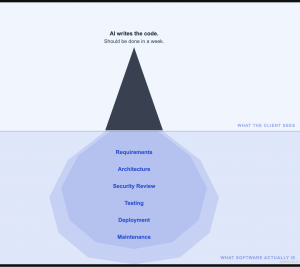
What those 45-minute demos do not show: the requirements gathering that takes days. The security review that catches what the AI missed. The testing that finds the edge cases. The deployment that handles real traffic. The maintenance that fixes what breaks at 3 am six months later. The person who is accountable when something goes wrong.
AI is a tool inside the development process. It makes certain parts of that process faster. It does not replace the process.
The real pain that software companies are sitting with right now
Here is what nobody outside the industry sees.
Software product companies are caught between two bad choices every single day.
Choice one: hold your ground, explain why the timeline is what it is, and lose the deal to a competitor who says yes to everything the client wants. That competitor will underdeliver. The client may find out in six months. But you lost the project today.
Choice two: Say yes to the compressed timeline and reduced budget. Cut testing. Skip the security review. Rush the architecture. Ship something you are not proud of. It works in the demo. It falls apart in production. Your reputation takes the damage even though the client created the conditions.
Both choices are painful. And the companies stuck between them are good companies. They know how to build software properly. They are just being priced out by a market that does not understand what “properly” costs.
The scariest part is what happens to clients who choose the cheapest option. They get fast software that is insecure. They face maintenance bills that cost more than the original build. And sometimes, they face a data breach in a system that was never properly secured. The savings on the project became the most expensive decision they made.
What AI actually changes, in plain words
AI tools genuinely help development teams work faster on certain things. Writing standard functions. Generating tests. Documentation. First drafts of repetitive code. These are real productivity gains, and good development teams are using them.
What this means in practice:
- Some things are faster. Certain tasks that used to take hours can now take less time. That is real. It does translate into some efficiency for clients.
- Some things are not faster. Understanding your business requirements cannot be rushed. Architecture decisions that affect how your software behaves in three years cannot be shortcut. Security review is not optional, and AI does not do it automatically. Testing for real-world edge cases takes the time it takes.
- Some things are now harder. Because AI generates code quickly, the review process is actually more important than it was before, not less. You now need to verify that what was generated is correct, secure, and appropriate for your specific situation. That takes a skilled person and real time.
The honest version: AI makes a good development team more efficient. It does not make a cheap team good. It does not replace judgment, experience, or accountability.
How to have this conversation without losing the deal
This is the part that matters most practically. How do you respond when the client pushes back on price and timeline, without sounding defensive or losing the work?
The mistake most software companies make is getting into a technical argument. They explain architecture. They talk about testing frameworks. The client’s eyes glaze over, and they still choose the cheaper option.
Here is what actually works.
- Agree with them first. Yes, AI has made parts of development faster. Acknowledge that directly. Do not be defensive about it. “You are right, AI tools have changed how we work, and we use them too.” This immediately makes the client feel heard and lowers their guard.
- Then make it about their risk, not your cost. “The question is not just how fast it can be built. The question is what happens to your business if it breaks, if there is a security problem, or if it cannot scale when you need it to.” This shifts the conversation from price to consequence. Most clients care deeply about protecting their business.
- Give them a comparison they can feel. “Building this in two weeks for half the cost is possible. Here is what would not be in that build: security testing, load testing, proper error handling, and deployment documentation. If something goes wrong in production, the fix will cost more than what you saved. Would you like me to show you what that breakdown looks like?”
- Show, do not tell. If you have a past project where cutting corners created expensive problems, share it anonymously. “We once had a client who went with a faster, cheaper option from another company. Six months later, they came to us to fix it. The repair cost three times the original build.” Real stories beat arguments every time.
- Offer a middle path. “We can build a lean first version in a shorter timeline. It will have the core features and proper security. We will document what we deferred to the next phase. You get something real faster, and we do not compromise on what matters.” This gives the client speed without asking your team to ship something broken.
The clients worth keeping
Here is something worth saying honestly.
Not every client who pushes back on price is a client you should fight to keep.
The client who genuinely believes software should be free because AI exists, who will not engage with the risk conversation, who will not consider a phased approach, and who will go with whoever promises the fastest and cheapest option, regardless of what that means for quality, that client will eventually cause you problems. You will build something under conditions that set you up to fail. And when it does not work perfectly, they will blame you.
The clients worth investing in are the ones who, when you have the honest conversation, respond with: “OK, help me understand what the difference in the build actually means for my business.” Those clients become long-term partners. They refer others. They come back for every new feature.
The ability to have an AI conversation clearly and confidently, without being defensive or dismissive of the client’s perspective, is one of the most important skills a software product company needs right now. Not because it will win every deal. Because it will win the right deals.
One last thought
AI is not the enemy here. It is genuinely a useful tool, and the industry should use it well.
The problem is the gap between what AI can do in a demo and what software product development actually requires in the real world. That gap is where software companies are losing business, and clients are making expensive mistakes.
The companies that learn to explain that gap clearly, simply, and without arrogance will build stronger client relationships than they have ever had. Because when the client who went with the cheap AI-speed option comes back with a broken product, they will know who gave them the honest answer.
Be that company.
We build software, and we help clients understand what they are actually buying. If you are on either side of this conversation and want to talk it through, reach out. No pitch.