Is Agentic-AI the right answer?
Imagine a scenario: At 3:17 AM on a weekend, an application server at a mid-size financial services company somewhere hosted in India crossed a memory threshold. Multiple alerts fired to the IT team. It went to the monitoring dashboard, and it sat there, amber, waiting.
At 8:44 AM on Monday, when the IT team arrived and opened the dashboard, they saw it. By then, the server had been running at degraded performance for five and a half hours. Some overnight batch jobs had failed silently. Customer-facing reports that should have been ready by 7 AM were not ready. The finance team had already raised a helpdesk ticket wondering where the reports were.
No one missed the alert because they were careless. It was missed because 847 alerts were generated between 11 PM and 7 AM, 23 of which were meaningful, and this was one. The night duty engineer had handled what he could between 11 PM and 3 AM and then gone home. Nobody saw it.
This is the infrastructure monitoring problem in its most honest form. Not a technology failure. Not a people failure. A model failure. The model of generating alerts and relying on humans to process them does not hold when infrastructure scales faster than headcount.
The question is not how to hire more L1 engineers to watch more dashboards. The question is whether watching dashboards should be a human job at all.
Why Monitoring Is Mandatory, and the Current Model Is Broken
Every piece of infrastructure sends signals. Servers report CPU load, memory usage, disk I/O. Applications report response times, error rates, transaction volumes. Databases report query performance, connection counts, replication lag. Networks report latency, packet loss, interface errors. Cloud services report API call volumes, cost anomalies, scaling events. Security tools report login anomalies, certificate expirations, configuration drift.
At a company with 50 servers, 15 applications, and three cloud environments, the monitoring stack generates tens of thousands of events per day in normal conditions. During an incident, a single root cause can generate thousands of related alerts simultaneously as upstream and downstream systems respond to the original problem.
A single infrastructure incident can trigger thousands of related alerts, each demanding attention while masking the root cause.
The traditional response to this was to hire L1 engineers. Build a Network Operations Centre. Run shift rotations. Train people to follow runbooks: if CPU is above 90% for more than 5 minutes, restart the service. If disk is above 85%, trigger a cleanup job. If this application throws error code 502 three times in a minute, escalate to the application team.
This model worked when infrastructure was smaller, incidents were less frequent, and the cost of the L1 team was proportionate to the value of the infrastructure they protected.
In 2026, none of those conditions hold for most Indian organisations. Infrastructure has scaled dramatically through digital transformation. Incidents are more frequent because the surface area is larger. And the L1 team has not scaled with the infrastructure because the cost is prohibitive.
84% of organisations have explored or piloted AI in observability by 2026. The transition is not theoretical. It is happening.
Alert Fatigue Is Not a Discipline Problem. It Is a Design Problem.
When an IT head tells me their team is missing alerts, the instinctive response in most organisations is to improve discipline. Better shift handovers. Stricter on-call rotations. More rigorous alert acknowledgement protocols. Training on prioritisation.
These interventions treat alert fatigue as a human failure. It is not. It is a design failure.
The current monitoring design generates alerts at a volume that exceeds human processing capacity and then asks humans to process all of them. Under this design, fatigue is not a deviation from normal operation. It is the inevitable outcome of normal operation.
AIOps platforms can reduce alert noise by 95% or more through intelligent correlation and deduplication. The same incident that generates 1,000 individual alerts from 1,000 monitoring rules can be correlated into a single coherent incident narrative. One thing went wrong. Here is what it is. Here is its probable root cause. Here is its business impact.
When the L1 engineer receives one coherent incident narrative instead of 1,000 individual alerts, their processing time drops, their accuracy increases, and their fatigue decreases. This is not automation. This is intelligence applied to the alert layer before the human sees anything.
The next step is what the user correctly identified: smart alerts combined with agentic AI that acts on the basic ones.
What Agentic-AI Monitoring Actually Does
The shift from traditional monitoring to agentic AI monitoring is not a difference in what is observed. It is a difference in what happens next.
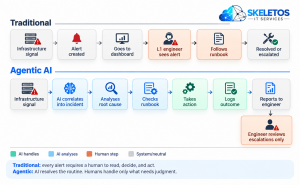
The difference is who does the runbook execution. In the traditional model, it is the L1 engineer. In the agentic model, it is the AI agent. For the large majority of infrastructure alerts that have known, documented remediation steps, this shift means the issue is resolved in seconds rather than minutes, at any hour, without requiring a human to be available and alert.
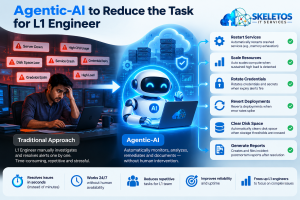
What agentic AI is already doing autonomously in production environments globally includes automatically restarting services that crash due to memory exhaustion, scaling compute resources when sustained high load is detected, rotating credentials and secrets when expiry alerts fire, reverting deployments when error rates spike after a release, clearing disk space when storage thresholds are crossed, and generating and filing incident postmortem reports after resolution.
ServiceNow event management reduces alert noise by 99% by surfacing actionable insights rather than raw alerts. DeepMind’s autonomous cooling system in data centres processes thousands of sensors every five minutes and adjusts cooling autonomously, reducing energy consumption by 40%.
This is not future technology. It is in production today at global scale.
The Three-Layer Model That Makes Sense in 2026
The right mental model for infrastructure monitoring in 2026 is not “monitoring and alerting.” It is three distinct layers with different roles for AI and humans at each layer.
- Layer 1: Observe and correlate. Every signal from every infrastructure component is ingested, correlated, and deduplicated into coherent incidents. The output of this layer is not 1,000 alerts. It is 5 coherent incident narratives with context, probable root cause, affected services, and business impact. AI does this. Humans see only the output.
- Layer 2: Reason and act. For each incident, the AI agent checks whether a documented runbook exists. If the issue matches a known pattern with a defined remediation step, the AI executes the remediation, logs the action, and marks the incident as resolved. If the issue does not match a known pattern, or if the required action exceeds the agent’s defined authority level, the incident is escalated to a human with full context already assembled. AI does the routine. Humans handle the novel.
- Layer 3: Govern and improve. Humans review the AI’s actions, maintain and improve the runbooks, define the authority boundaries that determine what the agent can do autonomously, and handle the escalated incidents that require business context and judgment. Over time, as the runbooks improve and the agent learns, more incident types move from escalation to autonomous resolution.
This is what organisations that have implemented agentic SRE are achieving. 30 to 70% reduction in Mean Time to Resolution in leading deployments. On-call burnout dramatically reduced. Engineers freed from mechanical incident response to focus on strategic reliability work.
The Indian SME Context: Why This Matters More Here
The global conversation about AIOps and agentic monitoring is mostly framed around large enterprises with dedicated SRE teams and mature observability stacks. The actual need in India is at a different scale, and it is arguably more urgent.
Consider the typical IT infrastructure of a mid-size Indian company. 200 employees. A Pune-based NBFC or a Pune-based auto components manufacturer. They run a core banking system or ERP, 20 to 30 servers, three cloud environments, a mix of on-premises and cloud applications, plus IoT devices on the factory floor or branch ATM infrastructure.
Their IT team size: Three people. Sometimes Five.
Those two or three people are not running shifts. They are not watching dashboards 24 hours a day. They come in at 9 AM, and they go home at 7 PM. Anything that goes wrong at night is discovered in the morning.
India’s BFSI sector’s mean time to contain a breach is 263 days. A significant part of that number is detection delay, which is a monitoring coverage problem.
A traditional 24×7 L1 NOC team for this infrastructure would require at minimum 6 to 8 people to cover round-the-clock shifts. At Indian IT compensation levels, that is a high cost for a 200-person company. Most companies cannot afford it.
Agentic AI monitoring provides 24×7 coverage without 24×7 staffing. The agent is always on. It processes every alert. It handles every routine remediation. It escalates critical issues at 3 AM with full context assembled so that when the IT head’s phone rings, they already know what the problem is, what the agent tried, and what they need to decide.
This is not a luxury feature for large enterprises. For Indian SMEs with small IT teams managing complex infrastructure, it is the only model that provides adequate coverage at a manageable cost.
What the L1 Engineer’s Job Actually Becomes
The concern about agentic AI replacing L1 engineers is understandable and worth addressing directly. The short answer is: the L1 engineer role as currently defined is being automated. The work that L1 engineers should be doing, which is different from the work they are currently doing, is not.
Currently, most L1 engineers spend 60 to 70% of their time on what is accurately described as task: repetitive, manual, mechanical work that is well-defined, documented in runbooks, and produces no permanent improvement in the infrastructure. Acknowledging alerts. Restarting services. Clearing caches. Filing incident tickets. Running health checks on schedule.
This is the work that agentic AI automates. Not because it is unimportant, but because it is mechanical. The same task, the same runbook, the same outcome, every time.
What remains for the human engineer, and what becomes more important as the routine is automated, is the work that genuinely requires human judgment. Designing and improving the runbooks that the AI follows. Defining the authority boundaries that determine what the AI can do without asking. Handling the novel incident that does not match any known pattern. Reading business context into a technical decision. Managing vendor relationships. Building the platform intelligence that makes the system smarter over time.
The common fear is job replacement, but the reality is role evolution. Platform engineering, AI Infrastructure Engineering, and DevSecOps are the clearest evolutions. Rather than engineers manually running pipelines and responding to every alert, engineers design self-healing, AI-operated infrastructure platforms and focus on reliability, cost optimisation, and strategic architecture decisions.
An L1 engineer who currently spends their shift acknowledging alerts and following runbooks is doing work that an AI agent will do better. An engineer who designs, governs, and continuously improves an agentic infrastructure platform is doing work that no AI agent can replace.
The transition between these two is the conversation every IT head in India needs to be having with their team right now.
What the Governance Layer Looks Like
The concern about agentic AI taking autonomous action on infrastructure is legitimate and worth taking seriously. An agent that restarts the wrong service, scales the wrong resource, or reverts the wrong deployment can cause more damage than the original incident.
The governance layer is what makes autonomous action safe.
Every action the agent can take is pre-approved by the engineering team. The agent does not decide what actions are permissible. Humans define the playbook. The agent executes from the playbook. Actions outside the playbook go to a human.
The authority levels work in tiers. Tier 1 actions: fully autonomous, no approval required, logged and reported. Restarting a specific set of approved services. Clearing specific log directories. Sending alert notifications. Tier 2 actions: proposed by the agent, approved by an on-call human before execution. Scaling resources. Reverting a deployment. Modifying a configuration. Tier 3 actions: require senior engineer involvement. Anything that touches production databases. Any infrastructure change with potential data loss implications. Any action on a system that affects regulatory reporting.
The agent learns from its actions. Each successful autonomous resolution improves the agent’s confidence model. Each failed action or unexpected outcome is reviewed, and the runbook is updated. Over time, the Tier 2 bucket shrinks as more actions achieve the confidence level required for Tier 1.
This is governed autonomy. Not unconstrained AI. Not rigid rule-based automation. An agent that operates within human-defined boundaries, learns from experience, and escalates appropriately at the boundaries of its authority.
Where to Start
For most Indian companies moving from traditional monitoring to agentic monitoring, the path is incremental rather than a wholesale replacement.
Start with the noise reduction layer. Implement event correlation and deduplication before touching autonomous action. If your current monitoring stack generates 500 alerts per shift and you can reduce that to 20 coherent incidents through correlation, your team’s effectiveness improves immediately without any autonomous action risk.
Then identify your highest-frequency, lowest-risk runbook actions. What does your team do most often that follows a completely documented, completely repeatable process? Service restarts are usually the first candidate. Disk cleanup. Log rotation. Certificate expiry alerts. These are your first automation candidates.
Build the governance framework before you automate. Define the authority tiers. Define what the agent can do alone, what requires approval, and what always requires a human. Document this. Get the team involved in defining it. The engineers who currently execute runbooks are the people who should design the automation that replaces those runbooks.
Measure the outcome. Track how many alerts the agent resolves each week autonomously. Track MTTR before and after. Track how many incidents required escalation. Track how many of those escalations were correctly identified by the agent versus missed. The data tells you where to expand the automation and where to pull back.
Final Thought
The infrastructure sent 847 alerts last night. Most of them were noise. Some of them were routine issues with known solutions. A few of them were genuinely important.
The L1 engineer’s job was to separate these categories and act on each appropriately. It is an important job. It was never designed to be done by a person reading a dashboard at 3 AM.
The agentic monitoring model does not eliminate the need for infrastructure expertise. It eliminates the parts of that job that should never have been manual in the first place. The routine. The mechanical. The repetitive.
What it creates space for is the work that actually requires a human. Designing the systems that prevent incidents rather than just responding to them. Building runbooks that are actually comprehensive. Improving the infrastructure rather than maintaining it. Making strategic decisions about what to run and how to run it.
The question for every IT head in India with a small team managing large infrastructure is not whether to automate the routine. The answer to that is obvious.
The question is how quickly to make the transition before the next 3 AM alert is the one that matters.
At Skeletos IT Services, we help Indian companies design and implement infrastructure monitoring architectures that combine smart event intelligence with governed agentic automation, giving small IT teams the 24×7 coverage that large enterprises buy with large headcount. If you want to understand what your current monitoring stack would look like with agentic response layered on top of it, and which runbooks are the right first automation candidates, we can help you map that.