In December 2025, the company rolled out Anthropic’s Claude Code (AI) to roughly 5,000 engineers. Within weeks, adoption was extraordinary. By spring 2026, 95% of engineers were using AI tools monthly. Around 70% of code commits were AI-driven. Usage of agentic AI features surged from 32% in February to 84% by March 2026. Lexology
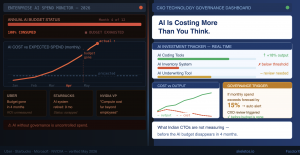
By April 2026, the entire annual AI budget was gone. Four months into a twelve-month plan.
Per-engineer monthly API costs had ballooned to between $500 and $2,000, blowing past internal forecasts. CTO Praveen Neppalli Naga confirmed that the full annual AI budget was exhausted by mid-April. India Briefing
And here is the part that should stop every CTO and CFO reading this: COO Andrew Macdonald put it plainly — it is very hard to draw a line between the AI usage statistics and actually producing more useful consumer features for customers. Lexology
Uber spent the equivalent of a full year’s AI budget in four months. And their own leadership cannot tell you whether it was worth it.
This Is Not an Uber Problem
In the same weeks that Uber’s CTO was conducting an internal review of AI spending, three other headline stories emerged that tell the same story from different angles.
Starbucks abandoned an AI-driven inventory management system introduced in stores across North America after workers reported persistent problems with inaccurate scans, incorrect item identification, and inventory mismatches. The system was retired nine months after deployment, part of CEO Brian Niccol’s turnaround campaign. The AI that was supposed to replace manual shelf counting could not reliably count a bottle of peppermint syrup. TsaaroKing Stubb & Kasiva
Microsoft cancelled its internal Claude Code licenses for its Experiences and Devices division — the teams behind Windows, Microsoft 365, Outlook, Teams, and Surface — effective June 30, 2026, barely six months after the pilot launched. To be precise about what happened here: Claude Code had become genuinely popular and superior in many workflows — so popular that it was directly displacing Microsoft’s own GitHub Copilot product internally. Microsoft did not cancel because AI failed. They cancelled because their own AI governance, specifically the strategic question of which tools their teams should use, had not been thought through before deployment. Shardul Amarchand MangaldasTCSA
And from the company that profits more from AI than anyone else on earth: Nvidia vice president of applied deep learning Bryan Catanzaro said plainly that for his team, the cost of compute is far beyond the costs of the employees. Huntress
Four organisations. Four public admissions. All in the same month. The common thread is not that AI is useless. The common thread is that nobody was governing the spend.
Why This Matters for Indian Companies Right Now
India’s boardrooms are having a version of this conversation every week. The CTO wants to deploy AI tools for the engineering team. The CEO has read about AI productivity gains and wants to move fast. The CFO is signing off on a budget that was derived from a vendor’s ROI calculator, not from a real assessment of the organisation’s specific context.
A 2024 MIT study found that AI automation is economically viable in only about 23% of jobs, with humans still cheaper in the remaining 77%. That number does not get quoted in vendor sales presentations. DevLogixCorporate
The Indian NBFC that deploys an AI underwriting tool. The manufacturer that replaces manual quality inspection with a computer vision system. The financial services firm that buys enterprise AI licences for its analyst team. Each of these is making a capital investment that their leadership cannot currently measure against returns.
The Uber scenario is not a cautionary tale about AI. It is a cautionary tale about deploying technology at scale without a governance framework that gives leadership real-time visibility into what the technology is costing and what it is producing. That is a problem that exists in Indian organisations of every size and sector, with and without AI.
What Went Wrong: The Common Failure Pattern
These are not isolated incidents from companies that made rookie mistakes. Uber, Microsoft, and Starbucks have some of the most sophisticated technology teams in the world. The failures follow a pattern that is structural, not accidental.
1. Adoption metrics were treated as success metrics
At Uber, 95% engineer adoption and 70% AI-driven code commits were celebrated internally. The usage numbers looked extraordinary. But usage is not value. The question that was not being asked in real time was: Is the software shipping faster? Are customer features improving? Is engineering output per dollar of cost increasing? By the time the COO acknowledged that the link between AI usage and useful consumer features simply was not there yet, the annual budget had already been consumed. Lexology
2. Cost per unit was not modelled at scale
Monthly API costs per engineer ranged from $500 to $2,000. Uber’s total R&D expenditure hit $3.4 billion in 2025, already a 9% year-over-year jump. These are not small numbers. But the cost per engineer per month was not flagged as a governance issue until the aggregate total had already exceeded the annual plan. The individual unit cost was invisible at the leadership level until the aggregate total became impossible to ignore. Lexology
3. The technology was deployed before the governance framework existed
Starbucks deployed its AI inventory system across over 11,000 North American stores. A demonstration video included in the original launch announcement inadvertently showed the scanning software overlooking a bottle of peppermint syrup during an employee demonstration. The performance gap was visible before full deployment. The governance framework that should have said “this system must hit a minimum accuracy threshold before we roll it out at scale” did not exist or did not hold. Dpdpa
4. Leadership found out from the numbers, not from the system
In each case, the signal that something was wrong came late — from a budget exhaustion report, from internal staff complaints, from a CTO’s post-deployment review. There was no real-time visibility layer that would have shown a CEO or CFO, week by week, whether the AI investment was tracking against its stated purpose. By the time leadership had enough information to make a governance decision, the cost had already been incurred.
The Question Indian CTOs Are Not Asking Before They Sign the AI Budget
Most AI deployment conversations in Indian organisations focus on three things: which tool to buy, how long implementation will take, and what the headline productivity gain is supposed to be.
The questions that are rarely asked are the ones that would have caught every one of the failures above.
What does success look like for this AI deployment, stated in a metric that leadership can measure monthly, not annually?
What is the cost per meaningful output unit, not per licence or per user, and at what usage level does that cost exceed the value delivered?
Who in the leadership team can see this data in real time, before the budget is exhausted, and with enough context to make a corrective decision?
If a CTO can answer the first two questions at the time of deployment, they will not build a governance blind spot. If a CEO or CFO cannot answer the third question, they are flying the organisation’s technology investment blind.
Despite unclear productivity gains and high costs, big tech companies have committed around $740 billion to AI-related expenses this year, a 69% jump from the prior year. That number reflects confidence, or at least momentum. It does not reflect measurement. DevLogixCorporate
This is the specific gap that FacctorX addresses. For organisations that are making or planning AI investments, a CXO dashboard that surfaces technology investment performance, cost versus output tracking, and early warning signals for budget overruns gives leadership the visibility layer that none of Uber, Microsoft, or Starbucks had in the months leading up to their public admissions. The problem is not that their CTOs were incompetent. The problem is that the data they needed to govern the investment was not in front of them at the right time, in the right format, for a business decision to be made.
Does This Mean AI Is a Failed Bet?
No. That is the wrong lesson, and it is worth being direct about it.
Inference costs for large language models are expected to drop more than 90% over the next four years, according to Gartner. The economics of AI will improve. The tools will improve. The gap between what AI promises and what it currently delivers, at least in many operational contexts, will narrow. LinkedIn
The right lesson from Uber, Starbucks, and Microsoft is not that AI does not work. It is that AI deployed without governance is not a transformation. It is an uncontrolled experiment with your technology budget.
Only about 18% of companies had adopted AI tools by the end of 2025. And widespread productivity gains or large-scale job displacement have not yet materialised. The organisations that will deploy AI well are not the ones that move fastest. They are the ones that define what success looks like before they deploy, measure it while they are deploying, and have a governance layer that catches drift before it becomes a public admission. LinkedIn
For Indian NBFCs, manufacturers, and financial services firms currently evaluating AI investments, the window before committing budget is the right time to build that governance framework. Not after the annual AI budget is gone in four months.
5 Things Indian CTOs and CFOs Must Put in Place Before the Next AI Budget Approval
1. Define a measurable output metric before deployment, not after
The metric must be specific to the business outcome, not to AI usage. Not “percentage of code commits that are AI-assisted.” Instead: “engineering release cycle time” or “defect rate per release.” Not “percentage of inventory counts automated.” Instead: “inventory accuracy rate versus baseline.” If you cannot state what success looks like before you deploy, you have no way to know whether you have achieved it.
2. Model total cost of ownership at realistic usage levels
Vendor pricing is typically presented at a per-seat or per-month level. The Uber experience shows that token consumption at full adoption can be dramatically higher than forecast. Before approving an AI budget, model the cost at 50%, 80%, and 100% adoption, and at the high end of per-user consumption ranges. The number that matters is not the per-seat price. It is the aggregate monthly cost at realistic usage.
3. Build a CXO-level visibility layer into the deployment from day one
The technology team should not be the only function that can see AI performance data. A CEO, CFO, or board member who cannot independently track the cost versus output of a major technology investment is dependent on the team managing it to surface problems. That dependency is what allowed four months to pass at Uber before the governance conversation happened. Leadership visibility into technology investment performance is not a luxury — for any investment above a certain materiality threshold, it is a governance requirement.
4. Set a review trigger, not just a review calendar
Annual reviews are too slow for AI deployments, where costs can move dramatically month to month. Set a specific trigger condition: if monthly AI spend exceeds X, or if the output metric falls below Y for Z consecutive weeks, a formal leadership review is automatically triggered. This is different from a scheduled quarterly review. It is a real-time governance mechanism that prevents drift from becoming a crisis.
5. Evaluate right-fit over best-in-class
Starbucks did not deploy a bad AI tool. They deployed a tool that had demonstrable accuracy limitations in their specific operational environment, a fast-moving retail store with variable shelf layouts and hundreds of SKUs. The question before deployment should not be “is this the best AI inventory tool available?” It should be “does this tool perform well enough, in our specific environment, to justify the cost and the operational disruption of deployment?” The answers to those two questions are often very different.
The Bigger Picture
What Uber, Starbucks, and Microsoft have in common is not that they made poor technology choices. It is that they made technology choices without the governance architecture to course-correct before costs escalated or outcomes disappointed.
That is not a problem unique to AI. It is the same problem that happens when Indian manufacturers buy ERP systems that their teams never fully adopt. When NBFCs deploy digital lending platforms that process applications correctly but generate compliance reports that nobody is monitoring. When financial services firms build custom software that works at go-live and slowly degrades as business processes evolve around it, but the software does not.
The technology is rarely the failure. The governance is.
AI has made this problem louder because the cost of getting governance wrong is faster and larger. Token-based pricing means a poorly governed AI deployment can exhaust an annual budget in four months. A poorly governed software implementation usually fails more slowly. But the root cause is the same: technology investment without real-time visibility for the people accountable for the outcome.
The companies navigating AI well are the ones whose leadership can answer a simple question at any point in the deployment: what is this costing, what is it producing, and is that ratio good enough to continue? If leadership cannot answer that question without waiting for a quarterly report, the deployment is not governed. It is hoped.
Final Thought
I have spoken with CTOs at Indian manufacturers and NBFCs who are under genuine pressure to deploy AI. Their boards have read the same headlines everyone else has. The question is not whether to use AI. That debate is largely settled. The question is whether the organisation has the governance infrastructure to deploy it responsibly, measure it honestly, and make corrections before the budget or the credibility is gone.
Uber had 5,000 engineers using AI tools enthusiastically. Starbucks had a CTO blog post. Microsoft had thousands of developers who genuinely preferred the tool over their own company’s product. None of that stopped the public acknowledgement of failure.
Enthusiasm and adoption metrics are not governance. They are signals that something is happening. The question governance answers is whether what is happening is worth what it costs.
That question belongs in the CXO’s hands, not just the CTO’s inbox.
At Skeletos IT Services, we help Indian companies across manufacturing, financial services, and NBFCs build the governance architecture that makes technology investment accountable, including AI deployments. FacctorX, our CXO dashboard, gives leadership real-time visibility into technology cost versus output, so the next AI budget conversation is informed by data, not assumptions. If you are evaluating an AI investment and want a framework before you commit, let us walk you through it.