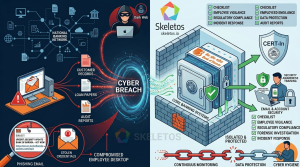
On July 24, 2026, a threat actor group called TripleX posted what it claimed was approximately one terabyte of Bank of Baroda customer data on the dark web. For free. Not as a ransom demand. As a statement about the bank’s security posture.
The dataset, reviewed by independent security researchers who found the samples credible, reportedly contains savings and current account records, loan applications, Aadhaar numbers, phone numbers, NRI banking data, corporate banking records, branch audit reports, and internal operational documents from multiple Bank of Baroda branches across India.
Three days later, on July 27, 2026, Bank of Baroda issued an official statement.
“The Bank has robust information security protocols in place. The incident involved compromise of an employee’s email account, resulting in unauthorised access to certain data. The matter was promptly identified, and immediate containment measures were implemented. The bank’s core banking systems were not accessed and continue to remain secure.” GalaxyWarden
Core banking systems untouched. Employee email account compromised. Investigation ongoing.
The statement is measured, accurate, and carefully constructed. It also carries a detail that every CISO, IT head, and board member at every Indian bank and NBFC needs to stop and read again.
The entry point was an employee’s email account.
Not a sophisticated supply chain attack. Not a zero-day exploit in the core banking software. Not a contractor’s misconfigured server at a third-party data centre, as we saw with Tata Electronics and Kudankulam. The attacker entered through an inbox.
Bank of Baroda acknowledged that due to an employee’s lack of digital hygiene, the email account was compromised, leading to the breach. BankInfoSecurity
One inbox. One compromised credential. Data belonging to potentially millions of Indian banking customers on the dark web.
India’s most significant confirmed banking breach of 2026 did not require technical sophistication. It required one employee to have a password that was not strong enough, reused from another platform, or obtainable through phishing. That is all TripleX needed.
Who TripleX Is and What Makes This Breach Different
The Triple X ransomware group published the data on the dark web on July 24. The relatively new group, first observed in May, primarily uses a double-extortion model: stealing data first, then threatening to leak it. Wikipedia
TripleX is not a well-known name in global ransomware circles yet. They first appeared in May 2026, when they breached PT Bank Negara Indonesia, one of Indonesia’s largest state-owned banks. Bank of Baroda appears to be their second major confirmed target, and the second state-owned bank in their short operational history.
The Bank of Baroda incident is unusual even within TripleX’s own pattern. Most ransomware groups following the double-extortion model demand payment before publishing data. TripleX published the Bank of Baroda data for free.
Rather than extorting the bank for a financial payout, TripleX posted the massive repository for free public download. On a threat monitoring platform, the hackers stated they published the data to punish the institution for allegedly weak passwords and security errors. The Week
This is significant for two reasons. First, it means the data is now permanently and freely accessible to anyone with a Tor browser and the motivation to look for it. There is no ransom payment that can retract it. Second, it reflects a deliberate choice to make an example of the institution rather than monetise the breach, which is a pattern that signals this group is interested in reputation and escalation as much as financial return.
For the millions of Bank of Baroda customers whose Aadhaar numbers, phone numbers, and financial records are now on that dark web listing, neither distinction provides any comfort.
How a Single Email Account Becomes 1TB of Exposure
This is the question every banking CTO and CISO needs to sit with, not because the answer is technically complex, but because it reveals a structural assumption about email that most banking organisations have never examined.
The email account in a bank is not simply a communication tool. It is the connective tissue of the entire organisation. Branch audit reports are emailed between teams. Customer application forms are forwarded to processing units. Loan appraisal documents are attached and sent. Internal communications about account investigations, vigilance reports, and operational assessments travel through email constantly.
Srikanth Lakshmanan, who reviewed sample documents, said: “This includes branch audits, loan appraisal documents, internal communications, vigilance investigations, BOBWorld audit reports, customer data including application forms across multiple BoB branches across the country.” Wikipedia
An email account with access to several years of this material is not simply an inbox. It is a data repository. And unlike the core banking system, which has multiple layers of access control, the email account typically authenticates with a single credential: a username and a password.
TripleX’s own public statements often highlight poor security hygiene and initial access gained through weak or reused credentials rather than sophisticated zero-day exploits.
The gap between the security sophistication of the core banking system and the security sophistication of the email account sitting alongside it is often enormous. Banks invest heavily in protecting the CBS. They invest significantly less in protecting the email environment that handles the documents, communications, and customer data flowing around the CBS.
TripleX found the gap. A single credential. An inbox with years of operational history. The connection between that inbox and customer data that should never have been accessible through email in the first place.
The Three Specific Failures This Breach Exposes
This incident is not a complex multi-vector attack. It is the same category of failure that we documented in the Raptech OAuth phishing case study earlier this year: an email account as the entry point, made possible by inadequate credential controls. The specific failures are different in mechanism but identical in outcome.
- Failure 1: Password hygiene treated as an individual responsibility rather than a technical control.
Bank of Baroda’s own statement describes the cause as a lack of digital hygiene. That phrase puts the responsibility squarely on the individual employee. The reality of password hygiene in large organisations is that individuals reliably fail at it. They reuse passwords across personal and professional accounts. They choose passwords that are memorable, not random. They do not rotate credentials unless forced to. This is not a character flaw. It is a predictable human behaviour pattern that security architecture must account for.
The control that removes individual password hygiene from the security equation is multi-factor authentication. MFA means that even a compromised password is insufficient for access. The attacker needs the second factor, which they do not have. If MFA was enforced on every Bank of Baroda employee email account, this breach would not happen through a compromised password.
The critical word is enforced. MFA that is optional is not a security control. It is an opt-in programme for security-conscious employees and an invisible gap for everyone else.
- Failure 2: Sensitive data flowing through email without governance.
The documents reportedly accessed through this branch audits, loan appraisals, customer application forms, and internal investigations should not be flowing through uncontrolled email environments. A branch audit containing customer account details emailed to a regional head is not a governed process. It is a convenience that creates data exposure at every step of the email journey.
The principle of data minimisation, which the DPDP Act requires, applies here. Sensitive customer data should move through controlled, audited systems, not email attachments. An employee email account should not be the repository of customer Aadhaar copies, loan documents, and financial records.
- Failure 3: No detection of unusual email data access before the dark web posting.
The breach was identified by the bank after the data appeared on the dark web. The detection came from an external signal, not from internal monitoring. This is the same pattern we saw in the Kudankulam contractor breach and the Bajaj Auto incident at its inception. The organisation discovers the compromise from outside, not from watching what is happening inside.
An email security system monitoring for anomalous data access, such as bulk downloads of attachments, forwarding of large volumes of messages to external addresses, or access from unusual geographic locations or devices, can detect a compromised email account being actively exploited before the attacker has had time to assemble and publish a dataset of that size.
The DPDP Act Exposure This Creates
The Bank of Baroda breach is not merely a cybersecurity incident. It is a data protection event of the first order under India’s DPDP Act.
The reported dataset includes Aadhaar numbers. Under India’s data protection framework, Aadhaar data is among the most sensitive personal information that exists. An individual cannot change their Aadhaar number if it is leaked. It is a permanent, biometric-linked identifier that, in combination with phone numbers and financial records, enables identity fraud, account takeover, and targeted social engineering at scale.
The DPDP Act requires Bank of Baroda to notify the Data Protection Board within the prescribed timeline following confirmation of a personal data breach. The Act requires notification to affected individuals. The Act requires that Bank of Baroda, as the Data Fiduciary, demonstrate that it had reasonable security safeguards in place.
Whether an employee email account protected only by a single password without enforced MFA constitutes “reasonable security safeguards” for a system holding customer Aadhaar data is a question the Data Protection Board will eventually be asked to answer.
The forensic investigation Bank of Baroda has initiated will need to determine not just how the email account was compromised but what data was accessible through that account, what data was actually exfiltrated, and whether the security controls in place at the time meet the DPDP Act’s requirements.
The RBI’s IT Governance Master Directions, which we covered in detail in our compliance roadmap last week, also carry specific requirements for incident notification and for the security of systems holding customer data. Bank of Baroda’s forensic disclosure and regulatory notifications will be measured against those requirements.
What Every Indian Bank and NBFC Must Do This Week
These are not general recommendations. They are the specific controls that would have changed the outcome of this breach.
- Enforce MFA on every employee email account without exception.
Not offered. Not recommended. Enforced. Every email login requires a second factor. MFA-resistant phishing attacks exist, but they require significantly more sophistication than the credential compromise TripleX used to access this account. Enforcing MFA on email closes the single-password vulnerability that this breach exploited.
- Audit what data is accessible through email and stop the flow of sensitive documents through uncontrolled inboxes.
Conduct an audit of what categories of customer data are being emailed between teams, branches, and processing units. Every document containing Aadhaar numbers, loan details, account information, or internal financial records that is attached to an email and forwarded creates an exposure point. These documents should be accessed through controlled, audited systems with access logging, not email attachments.
- Implement email data loss prevention controls.
DLP rules on the email environment flag and block outbound transmission of defined sensitive data categories including Aadhaar numbers, account numbers, and PAN card data. These rules do not prevent all data loss, but they create a specific barrier to bulk exfiltration of customer data through email and generate alerts when unusual volumes of sensitive data are leaving the environment.
- Deploy real-time monitoring for anomalous email access behaviour.
Modern email security platforms can detect when an account is being accessed from unusual locations, at unusual times, in unusual volumes, or through unusual device types. A compromised credential being actively exploited to download large volumes of attachments generates a behavioural signal that, if monitored, can trigger an alert before the exfiltration is complete.
- Run phishing simulation exercises specific to banking staff.
The most common mechanism for email credential compromise is phishing. An employee who clicks a realistic phishing email and enters their corporate email credentials has handed the attacker everything they need. Phishing simulation programmes send realistic test phishing emails to staff, measure who clicks and who complies, and use those results to target awareness training where it is most needed.
- Review which employees have email access to sensitive data categories.
The principle of least privilege applies to email as much as to any other system. Not every employee needs access to branch audit reports, loan appraisal documents, and customer application forms. An access review that maps which email accounts have access to which categories of sensitive data, and removes access where it is not operationally required, directly limits the blast radius of any future credential compromise.
- Build a credential compromise detection playbook.
When an employee account is identified as potentially compromised, the sequence of actions should be automatic and practiced: immediate session revocation, MFA reset, access audit for what was accessed during the compromise window, CERT-In notification if the threshold is met, and DPDP assessment of whether customer personal data was accessed. This playbook should exist, should be practiced, and should not be something the security team is building from scratch at 2 AM.
A Pattern India’s Banking Sector Must Acknowledge
Bank of Baroda is not alone in facing this category of risk. Looking at the documented breach history of Indian financial institutions over the past several years, the pattern is consistent.
A misconfigured cloud database exposed banking records in September 2025. A phishing campaign targeted ICICI Bank customers for credential theft in 2022. A third-party vendor exposed HDFC Bank ecosystem risk in 2023. And now, one employee email credential has led to the largest reported data exposure from an Indian public sector bank in recent memory.
Check Point recorded 3,195 attacks a week per Indian organisation in 2025, with India’s banking sector bearing a disproportionate share of targeting. CERT-In handled nearly 2.9 million cyber incidents in 2025 alone. Agbe India
The pattern across these incidents is not that Indian banks have worse technology than their global counterparts. It is that the gap between the security applied to core banking systems and the security applied to the surrounding environment. The email, the employee devices, the vendor portals, and the data flows connecting them are consistently wider than the threat environment requires.
The core banking system at Bank of Baroda is secure. The bank confirmed its core banking systems were not accessed and continue to remain secure. GalaxyWarden
But the data that should be protected by that secure core system is flowing through email accounts protected by single passwords. The fortress is strong. The communications leaving the fortress are not.
Final Thought
Bank of Baroda’s official statement used a specific phrase to describe what happened: an employee’s lack of digital hygiene.
I want to push back on that framing, not because it is wrong, but because it is incomplete.
Digital hygiene is an individual behaviour. Enforcing MFA is an organisational control. The difference matters because one approach creates a security posture that depends on every employee being vigilant every day, and the other creates a security posture that works regardless of what any individual employee does.
If 10,000 employees use corporate email and one of them has a weak password, that one weak password is the entry point. The other 9,999 can be fully security-aware, and the breach still happens.
TripleX published this data to send a message about Indian banking security standards. The message landed. But the response cannot be another awareness campaign. It has to be an architectural decision to remove the single-password email account as an attack surface for customer data, regardless of whether any individual employee practices good hygiene.
The question every Indian bank should be asking today is not whether their employees know what a phishing email looks like. It is whether a phishing email that succeeds gives an attacker access to anything worth having.
At Bank of Baroda, the answer was yes. That is the gap to close.
At Skeletos IT Services, we help Indian banks, NBFCs, and financial institutions build the email security architecture, access controls, and employee credential governance that removes the single-password email account as a viable attack surface. If you want to understand what data in your organisation is accessible through employee email accounts and what controls protect it, we can help you assess it.