Imagine receiving a call from someone who introduces themselves as calling from SBI’s fraud prevention team. They confirm your full name before you say a word. They read out your CIF number and ask you to verify it. They mention your branch. They reference that you applied for a loan last year. The call line shows a number that looks official.
You have no reason to doubt them.
They say there is suspicious activity on your account. They need you to verify your identity. An OTP is being sent to your registered mobile number right now. Could you please share it for verification? If you share it, the account is theirs.
The caller needed no hacking skills. No technical exploit. No credential theft. Everything they knew about you, your name, your CIF, your branch, your loan metadata, your mobile number, your date of birth, they found in a dataset circulating on the dark web.
This is not a hypothetical.
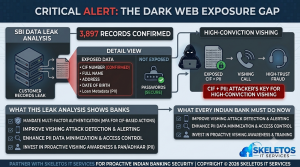
On October 16, 2026, SBI’s threat intelligence service provider, the Defence Cyber Agency, and CERT-In all alerted India’s largest bank about suspected customer data exposure on the dark web. After preliminary analysis of approximately 375,000 records, SBI identified 3,897 customer records containing personally identifiable information. The bank made a stock exchange disclosure on October 21.
The exposed data included registered mobile numbers, dates of birth, names, gender, email addresses, residential addresses, branch identifiers, Customer Information File identifiers, lead IDs, and metadata associated with loan and lead records.
No passwords. No PINs. No OTPs.
And yet the data in those 3,897 records is sufficient to construct a near-perfectly convincing impersonation of SBI reaching out to its own customers.
What a CIF Number Actually Is and Why Its Exposure Is Significant
Most news coverage of this incident focused on what was not leaked. No core banking credentials. No transaction data. No account balances.
What received less attention is the specific nature of what was leaked and why the combination is dangerous.
A Customer Information File, or CIF, is the bank’s unique internal identifier for each customer. It is the master record that links a customer’s identity to every product they hold with the bank: savings accounts, fixed deposits, loans, credit cards, demat accounts. When a bank employee, a call centre agent, or a self-service system wants to verify that a caller is who they claim to be, the CIF number is one of the verification factors.
The problem with CIF numbers being in the public domain is this: they were designed as internal identifiers, not as secrets shared with customers. Many customers do not know their own CIF number. When a caller demonstrates they know your CIF number, the instinctive reaction is to assume the caller must be from the bank.
The attacker who has your CIF number, combined with your name, mobile number, date of birth, residential address, and the knowledge that you have a loan application in the system, does not need a password. They have everything required to pass as a bank representative calling about your account.
This is what security professionals mean when they say context is currency. The individual pieces of data are relatively innocuous in isolation. Combined, they are a social engineering toolkit.
The Source Is Still Unknown, And That Is a Problem
SBI’s October 21 filing was clear on one point: the bank has not yet established where the data came from.
The bank received alerts from CERT-In and the Defence Cyber Agency on October 16. It then conducted a preliminary analysis of the dark web dataset. It confirmed the 3,897 affected records. It said a detailed investigation is underway.
What it did not confirm is whether the data came from SBI’s own systems, from a subsidiary, or from a third-party vendor.
This matters enormously.
If the data came from SBI’s own systems, it reflects an internal data security failure. If it came from a subsidiary or third-party vendor, it reflects the exact problem that multiple Indian regulatory frameworks have been increasingly focused on: the security controls that a regulated institution applies to its own systems are only as effective as the controls it requires of its vendors and partners.
Breaches rarely happen through the front door. Continuous compliance and access audits across vendor ecosystems and subsidiaries are non-negotiable.
The two Indian banks breached through a shared technology vendor in April 2026, the Tata Electronics contractor breach in June 2026, the Kudankulam incident where contractor data ended up on a commercial server: each of these demonstrated that the most sensitive customer data often leaves the institution through the least secured exit.
Until SBI’s investigation establishes the source, every bank and NBFC reading this blog should be running the same question across their own vendor and subsidiary landscape: if a dataset containing our customer CIF numbers appeared on a dark web marketplace, which system or partner relationship would be the most likely source?
What Attackers Do With CIF-Level Data
The LinkedIn post that brought this incident to attention frames the risk precisely. When attackers get their hands on PII combined with internal markers like CIF numbers, the game shifts from brute force to high-conviction deception.
The attack chain that this data enables is specific.
- Vishing with full customer context. A call to an SBI customer that correctly states their name, CIF number, branch, and loan metadata is not a generic scam call. It is a targeted social engineering operation. The customer has no context against which to evaluate whether the caller is legitimate, because the information the caller knows is information that only the bank was supposed to have. The psychological barrier to compliance is dramatically reduced.
- Spear phishing with personalised lures. An email or SMS that addresses the recipient by name, references their specific branch and CIF number, and raises a concern about their loan application is not filtered by the generic scam-detection heuristic of “this looks suspicious.” It looks specific. It looks informed. The probability that the recipient clicks or responds is significantly higher than with a generic phishing attempt.
- Identity confirmation for account recovery. Many banks and fintech platforms use knowledge-based authentication for account recovery: provide your date of birth, your registered mobile number, your address. All of these are in the leaked dataset. An attacker who wants to initiate an account recovery process on a platform that the SBI customer also uses now has everything they need to pass the knowledge-based verification.
- Secondary credential harvesting. The customer who receives the well-researched vishing call and shares an OTP has handed over the one credential the attacker did not have. The dataset provided the context. The OTP was the only remaining piece. The timing of the call can be engineered to coincide with when the customer is most likely to receive a transaction OTP.
What the DPDP Act Required of SBI
Digital rights group the Internet Freedom Foundation raised a specific and important question after the SBI filing: while the bank disclosed the incident to the stock exchanges, it had not directly notified the 3,897 affected customers at the time of disclosure.
A customer notice, a press release, or an advisory from SBI informing the 3,897 customers was not available publicly as of the disclosure.
India’s Digital Personal Data Protection Act creates an obligation on Data Fiduciaries to notify the Data Protection Board and affected data principals in the event of a personal data breach. SBI is a Data Fiduciary. The 3,897 customers whose PII was confirmed in the dark web dataset are data principals. Their names, mobile numbers, dates of birth, residential addresses, email addresses, and CIF identifiers are personal data.
The stock exchange filing fulfils a SEBI obligation. It does not fulfil the DPDP notification obligation to the affected customers.
The customers who are most at risk from the high-conviction vishing and spear phishing attacks described above are the ones who do not know their data was on the dark web. Without notification, they have no heightened alertness. They have no reason to be more cautious than usual about calls from SBI. The attacker’s timing advantage is maximised when the target does not know they have been exposed.
Customer notification is not just a regulatory obligation. It is the most effective countermeasure available once the data has already leaked.
What Every Indian Bank and NBFC Must Do Right Now
This incident carries specific action items for every financial institution in India, regardless of whether they believe their data is in the current dataset.
Action 1: Audit your vendor and subsidiary data access landscape this week.
SBI has not identified the source of the leak. That ambiguity is a mirror for every bank and NBFC to look into. Map every third-party vendor, partner, and subsidiary that has access to customer PII, including names, mobile numbers, dates of birth, addresses, and account identifiers. For each one, document what data they can access, what controls govern that access, when that access was last audited, and what their contractual data security obligations are.
The RBI’s July 2026 Cybersecurity Framework for commercial banks, which we covered in detail on this blog, explicitly requires extensive third-party due diligence including contractual security requirements, incident reporting obligations, and continuous monitoring of critical vendors. This is now a mandatory framework, not a recommendation.
Action 2: Move identity verification away from static data points.
CIF numbers, dates of birth, mobile numbers, and addresses are all now potentially compromised for a segment of Indian banking customers. Any identity verification process that relies on these static data points as the sole or primary verification factor is insufficient.
Dynamic verification, meaning verification that generates something new and time-limited for each interaction rather than relying on persistent data, is the architecture that remains secure even when static identifiers have been exposed. This includes step-up MFA for support interactions, time-limited verification codes sent via multiple channels, and behavioural verification that assesses whether the interaction pattern matches the customer’s historical profile.
Action 3: Alert customers directly and specifically.
The 3,897 confirmed customers in SBI’s case deserve direct notification that their data was found in a dark web dataset, that no passwords were exposed, and precisely what to be vigilant about: calls that reference their CIF number and personal details, requests to share OTPs, and unsolicited account security requests via any channel.
Every bank and NBFC should model this response. If your institution discovered tomorrow that customer CIF numbers and PII were in a dark web dataset, what is your customer notification protocol? Who sends the notification, through which channel, within what timeframe, and with what specific guidance? This protocol should exist before the incident, not be designed during it.
Action 4: Govern third-party device and network access with a network access control layer.
The most common pathway for PII to leave a banking environment without direct system compromise is through third-party access. Vendors who access customer data systems through shared portals, contractors who work with customer records through network connections that lack adequate monitoring, integration partners whose API access to customer data is insufficiently restricted.
EasyNAC provides real-time visibility into every device connecting to a bank’s or NBFC’s network. A vendor’s laptop connecting to the network and then performing unusual bulk queries against customer data is visible at the network layer regardless of whether the application layer logged the activity. Network-level monitoring that treats vendor devices as governed entities, placed in restricted VLANs with access only to the systems required for their specific function, is the control that closes the most common unmonitored exit for customer data.
Action 5: Train customer-facing teams on the social engineering capability this data enables.
Every SBI branch employee, every call centre agent, every relationship manager needs to understand that for a period following this incident, customer calls may come from individuals who know CIF numbers, personal details, and loan metadata that would normally indicate they are the real customer.
Internal training should specifically cover what to do when a customer claims someone called them from SBI and correctly quoted their account details. The answer is never “that must have been us.” The answer is a direct escalation to fraud monitoring with full documentation of the reported call.
The Broader Pattern of Indian Banking Data Exposure in 2026
The SBI disclosure arrives in a year that has seen repeated evidence of customer data from India’s financial sector reaching the dark web.
The Bank of Baroda breach in July 2026 involved a single compromised employee email credential that exposed customer data and was confirmed via a BSE filing. The two banks breached through a shared vendor in April 2026 demonstrated that one vendor relationship can create simultaneous exposure across multiple institutions. ICICI Bank’s vendor portal incident involved malware deployed against a third-party access point.
In each of these cases, the initial compromise vector was not a direct attack on the bank’s core systems. It was a connected point in the ecosystem: a vendor, an employee credential, a third-party portal.
The SBI incident follows the same pattern even before the source is identified. 375,000 records on the dark web. 3,897 confirmed SBI customer records. The source is unknown. The most likely candidates, based on the pattern of 2026’s BFSI incidents, are a vendor, a subsidiary, or a third-party integration that had access to the customer data in that dataset.
India’s banking sector cannot secure its data by securing only its own systems. It must secure every access point through which that data can leave.
Final Thought
The call I described at the beginning of this blog is not a theoretical risk for SBI customers following the October 2026 disclosure. It is a probable near-term event.
The dataset is on the dark web. The CIF numbers, names, mobile numbers, and loan metadata are in criminal hands. The operational playbook for converting this data into financial fraud, contextual vishing, spear phishing, and OTP harvesting is well established and documented across Indian cybercrime reports.
The customers who will be targeted are the ones who do not know their data was exposed, because SBI’s stock exchange filing reached investors and journalists rather than reaching them directly.
Every Indian bank and NBFC should read this incident as a preview. Not because their data is necessarily in the current dataset. But because the combination of customer PII and internal banking identifiers, circulating on dark web markets, is the raw material for the most convincing bank fraud that Indian customers will encounter.
The phrase “no passwords were leaked” is only reassuring if passwords are the only path to a customer’s account.
They are not.
At Skeletos IT Services, we help Indian banks, NBFCs, and fintech companies audit their vendor data access landscape, implement network-level controls that govern third-party device connections, and build the governance architecture that makes customer PII traceable, governed, and protected at every exit point. If you want to understand which vendor relationships in your ecosystem currently have unmonitored access to customer data, we can help you map that.
Note: This blog is based on SBI’s stock exchange filing dated October 21, 2026, as confirmed and reported by The Hacker News, Business Standard, The Wire, Tech Insider, and ETBFSI. All factual claims about the incident are drawn from verified public sources. The source of the SBI data leak remains under investigation at the time of writing. This blog is for awareness and educational purposes.