
At 10:41 AM on October 3, 2026, the first of 43 transactions began moving through a field agent’s mobile application connected to RapiPay Fintech’s Yes Bank account.
At 11:04 AM, the 43rd transaction was completed.
In those 23 minutes, ₹1.56 crore was distributed across multiple bank accounts. By the time anyone at RapiPay understood what had happened, the money had already moved.
An FIR has been registered at the Noida Cyber Crime Police Station. Investigators are now tracing beneficiary accounts, examining IFSC codes and RRN numbers, mapping linked mobile numbers and UPI IDs, and trying to reconstruct how someone obtained access to a field agent’s mobile application and used it to execute 43 transactions in less time than it takes to attend a morning standup meeting.
RapiPay Fintech is a well-established company. Founded in 2009 and headquartered in New Delhi, it operates a PAN-India network of over 6 lakh Direct Business Outlets as a business correspondent for banks. Its field agents provide Aadhaar Enabled Payment System (AEPS), micro ATM, money transfer, and utility bill payments to customers across India, particularly in rural and semi-urban areas.
The company has not accused the field agent of fraud. The current investigation points to unauthorised access to the mobile device or the application itself.
One legitimate field agent. One compromised endpoint or application session. 23 minutes. ₹1.56 crore.
The question the original reporting asks is the most important one for every fintech CTO in India: Is your organisation capable of detecting and stopping 43 suspicious transactions before the 23rd minute?
Most are not. This blog explains why, and what needs to change.
Understanding the Field Agent Model and Why It Creates Specific Risk
To understand the RapiPay incident properly, you need to understand what a field agent model is and why it carries a different security profile from a standard mobile banking application.
RapiPay’s field agents are authorised individuals, often small shop owners or service providers, who are registered as direct business outlets. They receive a mobile application that allows them to initiate financial transactions on behalf of their customers. A customer walks in, provides their Aadhaar number, authenticates with a biometric, and the agent processes the transaction.
This is a legitimate and valuable model for financial inclusion in India. It serves populations that do not have direct bank access. But from a security architecture perspective, it creates a specific challenge that standard consumer banking applications do not face.
The field agent’s application has real transactional authority. It can initiate money transfers. It can process payments. It can move funds. That authority is delegated to the device and the application session. In a standard consumer banking app, the user is transacting their own money. In a field agent app, the operator is transacting on behalf of the platform. The blast radius of a compromised session is therefore much larger.
When the session was compromised in the RapiPay case, whoever held that session held the authority to initiate transactions at scale. 43 transactions in 23 minutes is not a human typing at a keyboard. That velocity suggests either programmatic automation or a preconfigured attack script executing against the application’s API. The attacker was not cautious. They moved as fast as the system allowed them to.
And the system allowed them to move for 23 minutes.
The Failure Chain Behind 23 Minutes of Silent Fraud
Every major fraud incident has a failure chain. Not one control that failed, but several that were absent or insufficient. The RapiPay incident, based on what is publicly reported, suggests at least five gaps in the security architecture.
- No transaction velocity limit at the application or API level. 43 transactions in 23 minutes from a single session averages to a transaction every 32 seconds. A legitimate field agent conducting normal business does not process a transaction every 32 seconds. Transaction velocity, measured as the number of transactions per session per time window, is one of the most basic fraud detection signals. A rule that says “flag and pause if more than X transactions are initiated from a single session in Y minutes” would have triggered at transaction 5 or 10. It clearly did not.
- No session behavioural monitoring. A legitimate field agent has a usage pattern. Time of day. Transaction frequency. Geographic location. Customer demographics. When a session deviates dramatically from the historical pattern of that agent, it is a signal. 43 transactions in 23 minutes, if the agent’s historical average is 15 to 20 transactions per day, is a standard deviation event that should have been visible to any behavioural monitoring system.
- No real-time alert to an operations team. The most important question in this incident is not what happened. It is when RapiPay knew. If they discovered the fraud after the transactions were completed, there was no real-time monitoring of transaction activity feeding into an operations alert. A real-time monitoring system that surfaces anomalous transaction patterns to a human operator in real time would have allowed intervention at transaction 5, 10, or 15. 43 completed transactions mean the detection came after the fact.
- No automated session suspension on velocity breach. Even if no human was watching the dashboard in real time, an automated rule that suspends a session after a velocity threshold is crossed requires no human involvement. The rule fires. The session is suspended. The 44th transaction never happens. The attacker is denied. The remaining funds stay in the account. This is basic automated fraud prevention. It was either absent or set to a threshold that 43 transactions did not cross.
- No device binding or integrity check. If the attacker gained access to the application through a compromised device or a cloned session, a device binding control, which ties a valid application session to a specific registered device fingerprint, would have flagged the discrepancy at the first transaction. The legitimate field agent’s device fingerprint would not match the attacker’s device. The session would have been challenged or terminated.
None of these are exotic controls. They are standard components of a mature fintech security architecture. Their absence, individually or collectively, is what gave the attacker 23 minutes.
What the RBI and DPDP Frameworks Say About This
This incident does not exist in a regulatory vacuum. Two frameworks apply directly.
- RBI guidelines on fraud risk management and monitoring. RBI’s Master Direction on Fraud Risk Management requires regulated entities and their business correspondents to implement real-time transaction monitoring for anomalous patterns, automated alerts for suspicious activity, and defined escalation protocols. The field agent model, operating under a business correspondent framework, falls within the scope of these directions. A breach through a business correspondent’s application is a reportable event and potentially triggers RBI supervisory attention.
- DPDP Act implications. The transactions involved Aadhaar-authenticated financial records, customer identity data, and financial transaction data. Any breach that compromises this data category is a personal data breach under the DPDP Act, with notification obligations to the Data Protection Board and to affected customers within prescribed timelines. RapiPay’s investigation into what data was accessed through the compromised session will determine the scope of these obligations.
The regulatory exposure from this incident is not limited to the ₹1.56 crore loss. If the investigation finds that customer data was accessed or exposed, the regulatory and reputational consequences extend significantly beyond the financial loss.
The 8-Layer Security Architecture Every Fintech Field Agent Platform Must Have
This section is the practical action plan for every CTO running a field agent or business correspondent model. These are not recommendations. They are the specific controls that would have changed the outcome on October 3.
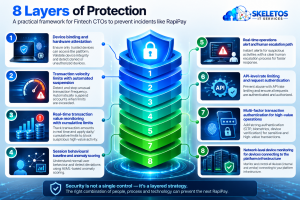
- Layer 1: Device binding and hardware attestation. Bind every field agent’s application session to a specific, registered device. The application must verify at each session initiation that the device fingerprint matches the registered device for that agent. If the fingerprint does not match, the session is challenged with additional authentication and not allowed to proceed. If the device has been rooted, jailbroken, or shows signs of tampering, the application refuses to operate. This is the control that stops session hijacking at the point of entry.
- Layer 2: Transaction velocity limits with automated suspension. Define a maximum number of transactions per session per time window for each agent tier. An agent whose historical pattern is 15 transactions per day should have a velocity limit that reflects their normal operating envelope, perhaps 10 transactions per hour as a soft limit, with a hard limit that triggers automatic session suspension and alerts. The specific thresholds depend on the agent’s business profile. The principle is fixed: no session should be able to process 43 transactions in 23 minutes without triggering a control.
- Layer 3: Real-time transaction value monitoring with cumulative limits. Beyond velocity, sessions should also have limits on cumulative transaction value. An agent who normally processes small-value transactions has an expected session value range. 43 transactions totalling ₹1.56 crore implies an average transaction of approximately ₹3.6 lakh each. If this agent’s historical average is ₹2,000 to ₹5,000 per transaction, the third or fourth transaction at ₹3.6 lakh should have triggered an anomaly. Cumulative session value monitoring flags this.
- Layer 4: Session behavioural baseline and anomaly scoring. Every field agent’s historical session behaviour creates a baseline. Time of day active. Average transaction count. Average transaction value. Geographic location. Transaction type distribution. When a live session deviates from this baseline beyond a defined threshold, it receives an elevated anomaly score. Scores above a defined level trigger challenges, reviews, or suspension. This is the control that catches the attacker who has valid credentials but operates differently from the legitimate agent.
- Layer 5: Real-time operations alert and human escalation path. An automated alert system is not a substitute for human awareness. Anomalous sessions should surface immediately to a human operator who can review and intervene. The alert must include: which agent, which session, what triggered the alert, transaction count and value so far, and a one-click action to suspend the session. The operator must be able to act in under two minutes of receiving the alert. If the escalation path takes longer, the session runs longer.
- Layer 6: API-level rate limiting and request authentication. If the attacker was executing transactions programmatically through the application’s API rather than through the application UI, API-level controls are the defence. Rate limiting restricts the number of API calls per session per time window. Request signing ensures that API calls carry a valid cryptographic signature that cannot be replayed or forged. These controls operate independently of the application layer and stop API-level automation attacks that bypass the UI entirely.
- Layer 7: Multi-factor transaction authentication for high-value operations. For transactions above a defined value threshold, require a second authentication factor beyond the application session. This can be a one-time PIN sent to the registered mobile number, a biometric re-authentication, or a transaction PIN distinct from the login credential. An attacker who has compromised the application session does not automatically have access to the second factor. High-value transaction MFA breaks the automated attack at the point where the individual transaction value crosses the threshold.
- Layer 8: Network-level device monitoring for devices connecting to the platform infrastructure. EasyNAC provides the network visibility layer that governs what devices are connecting to the corporate infrastructure supporting the field agent platform. While the field agent attack happened at the application layer, the broader security architecture requires visibility into every device connecting to RapiPay’s own network: the servers, the operations team workstations, the monitoring systems, the database servers. If an attacker gained initial access through an internal pathway rather than only through the external field agent application, EasyNAC would identify the unexpected device connection the moment it appeared on the network. No device connecting to the infrastructure that is not known, registered, and governed represents a gap.
The Incident Response Protocol That Must Exist Before the Next Attack
The RapiPay incident has a second lesson beyond the preventive controls. Even if some of the above controls were in place, what should have happened the moment the first anomaly fired?
- Minute 0 to 2: Automated detection and session suspension. The velocity control fires at the transaction threshold. The session is automatically suspended. No more transactions can be initiated. An automated alert goes to the operations team with full session context.
- Minute 2 to 5: Human review and decision. An operations team member reviews the alert. Sees 10 or 12 transactions. Confirms this is anomalous. Confirms the session suspension. Initiates the agent verification process to determine if the agent is aware of and authorised these transactions.
- Minute 5 to 10: Escalation and freezing. Operations escalates to the fraud team. The fraud team initiates a hold request to Yes Bank for any transactions that have already been submitted but not yet settled. Transactions in clearing can sometimes be recalled before funds leave.
- Minute 10 to 30: DFIR initiation. The digital forensics and incident response team begins preserving session logs, API call records, device metadata, transaction records, and all other forensic evidence before any system cleanup or restoration. Nothing is modified. Everything is preserved.
- Minute 30 onwards: Law enforcement and regulatory notification. FIR filed. RBI notified per their fraud reporting requirements. CERT-In notified within the 6-hour window if the incident qualifies. Customer notification process initiated if customer data was exposed.
The difference between this protocol and what actually happened is the difference between ₹1.56 crore lost and perhaps ₹15 to 20 lakh lost before the automated suspension fired and the human intervention stopped the remaining 30 transactions.
Why This Pattern Will Repeat Across India’s Fintech Sector
RapiPay is not the only company running a field agent or business correspondent model. There are hundreds of fintech companies, payment aggregators, and NBFC-linked entities that have distributed field agent networks across India. The model is fundamental to India’s financial inclusion mission.
Each of those field agents carries a mobile application with real transactional authority. Each of those applications is a potential entry point. The security posture across this landscape varies enormously, from well-funded fintech companies with mature security teams to smaller business correspondents operating with minimal security infrastructure.
The regulatory direction is clear. RBI’s ongoing tightening of business correspondent framework guidelines, its fraud risk management directions, and the new Cybersecurity Framework for commercial banks all point in the same direction: real-time monitoring, anomaly detection, and rapid incident response are not optional for entities handling financial transactions.
What is not clear is how many of these entities have implemented the specific controls described above. The RapiPay incident is an on-the-record test case. 43 transactions. 23 minutes. No intervention. The controls were either absent or set to thresholds that the attack did not trigger.
Every fintech CTO who reads this incident and thinks “our system would have caught this” should run the test. Initiate a simulated velocity test on a test account. See what fires and when. The answer may be more uncomfortable than expected.
The Implementation Roadmap for the Next 90 Days
For the CTO who has read this and wants to know where to start, here is the sequence.
- Days 1 to 14: Audit current velocity and anomaly controls. Review what transaction monitoring rules currently exist. Test whether they would have caught the RapiPay pattern (43 transactions in 23 minutes). Document the gaps. Present the audit to the board with the RapiPay incident as context. This is a board-level awareness moment, not an IT team memo.
- Days 15 to 30: Implement transaction velocity limits and automated session suspension. This is the highest-priority control. Define thresholds. Implement at the API layer and the application layer. Test in staging. Deploy to production. This single control alone would have stopped the RapiPay attack at transaction 10 or earlier.
- Days 31 to 60: Deploy real-time operations alerting. Build the dashboard and alerting workflow that puts anomalous session data in front of a human operator in real time. Define the escalation path. Define the action playbook. Train the operations team on the process.
- Days 61 to 90: Implement device binding and session behavioural baseline. Device fingerprinting and session behaviour profiling require more build time and data collection. Start now. The first version does not need to be perfect. A device that has never connected before is a signal even without a full behavioural model.
- Ongoing: Test, review, and improve. Run simulated attacks against your own system quarterly. Review every real anomaly that triggered your controls, whether it was fraud or a false positive. Improve the thresholds. Improve the playbooks. The threat evolves. The controls must evolve with it.
Final Thought
RapiPay Fintech provides essential financial services to people who do not have easy access to banks. That mission is genuinely important. The field agent model it operates is fundamental to India’s financial inclusion story.
The attacker who exploited a compromised endpoint on October 3 was not attacking a careless company. They were attacking a model that has inherent security complexity because it delegates transactional authority to distributed, hard-to-control endpoints at the edge of the system.
That complexity is not a reason to abandon the model. It is a reason to build the security architecture that the model requires. Transaction velocity controls. Real-time monitoring. Device binding. Automated suspension. Rapid incident response. The controls exist. They are implementable. They are proportionate to the risk.
The question the original post asks is the right one. Can your organisation detect and stop 43 suspicious transactions before the 23rd minute?
Build the system that can. The 24th minute is too late.
At Skeletos IT Services, we help Indian fintech companies, NBFCs, and payment firms build the monitoring, alerting, and incident response architecture that makes anomalous transaction patterns visible in real time and stoppable before significant damage occurs. If you want to understand what your current field agent or digital transaction platform would look like under a RapiPay-style attack scenario, and where the detection gaps sit, we can help you find out.
Note: This blog is based on verified reporting from The420.in, News4Hackers, and Amar Ujala, published October 7-8, 2026, referencing the Noida Cyber Crime Police Station FIR related to the RapiPay Fintech incident of October 3, 2026. The investigation is ongoing, and the company has not confirmed all details publicly. This blog is for educational and awareness purposes.