Eight months into their HRMS implementation, the HR head of a Pune-based manufacturing company made a list.
Not a list of problems. A list of processes her team had changed since the software went live.
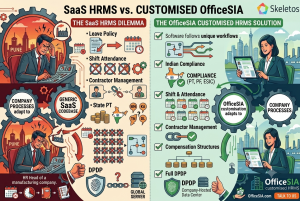
Leave policy restructured to match the platform’s leave categories. Shift attendance tracking moved from their existing system to the platform’s method, which handled it differently. Contractor management workflow redesigned because the SaaS did not support their previous model. Performance review cycle timing shifted to align with the platform’s appraisal module. Professional tax configuration across three states was handled manually because the automation did not correctly match state-specific rules.
When she counted, her team had changed eleven of their fifteen core HR processes to fit what the software could do.
She had bought HRMS software to make her team’s work more efficient. Eight months later, her team was working to make the software’s job easier.
This is the experience that most Indian companies do not publicly discuss after a SaaS HRMS implementation. Not because it is unusual. Because it is standard.
What the SaaS HRMS Promise Actually Delivers
The case for SaaS HRMS is genuine and not without merit.
Lower upfront cost. No server infrastructure to manage. Automatic updates. Access from anywhere. A product built and maintained by a team whose entire business is making HR software work.
For a company whose HR processes are broadly standard, whose compliance needs are straightforward, and whose workforce is primarily white-collar and urban, a reputable SaaS HRMS will deliver on most of that promise.
The problem is that most Indian companies are not that company.
India’s HR compliance landscape is genuinely complex. DPDP Act covers salary records, biometric attendance data, health and insurance records, performance reviews, background verification reports, and any other employee information stored or processed digitally. Layered on top of that is the Provident Fund structure with state-level variations, Professional Tax rates that differ across states and income brackets, ESIC coverage thresholds, gratuity calculations, contract labour regulations under the Contract Labour Act, and the state-specific implications of India’s four new Labour Codes that are being implemented in phases.
A garment manufacturer in Surat managing 800 contract workers, 200 permanent staff, and seasonal hiring peaks has a completely different HR compliance architecture from a fintech company in Bengaluru with 150 employees on standard payroll. A manufacturing plant in Maharashtra with three-shift attendance and biometric tracking at the factory gate has different data collection requirements than a consulting firm with remote employees filing attendance through a mobile app.
SaaS HRMS platforms are built for the median. They are designed to serve thousands of companies across India and globally with one codebase. That codebase reflects the median company’s requirements. The farther your company’s actual requirements sit from that median, the more your team ends up working around the software rather than with it.
The Process Reversal Problem
There is a specific failure mode in SaaS HRMS implementations that deserves its own name. Call it the process reversal.
It works like this.
A company buys an HRMS to automate and improve its HR processes. During implementation, the team discovers that the software handles a specific process differently from how the company currently does it. The software vendor says this is by design, that the platform was built for a specific workflow, and that customisation is either not available in the plan or available only at additional cost.
The company has two options. Pay for customisation. Or change the process.
Paying for customisation on a SaaS platform often costs more than anticipated, takes longer than projected, and produces results that may revert or break with the next platform update. Changing the process is faster and cheaper in the short term.
So the company changes the process.
Then the next process reveals a similar constraint. The company changes that process too. And the next. And the one after.
By the time the implementation is complete, the company has a running HRMS and an HR team that has fundamentally changed how it operates. Not because the new way was better. Because the software required it.
The HR head I described in the opening was not unusual. She was typical. The only thing unusual was that she counted.
Software exists to serve the organisation. When the organisation changes itself to serve the software, the relationship has reversed. The tool is running the operation.
What Indian HR Compliance Actually Requires
The complexity of Indian HR compliance is the specific reason that the process reversal problem is more acute here than in many other markets.
- Payroll compliance across states. Professional Tax is levied by state governments, and the slabs, exemptions, and filing requirements differ materially across Maharashtra, Karnataka, West Bengal, Andhra Pradesh, Telangana, and others. A company with employees in multiple states needs a payroll system that handles each state’s rules accurately. Generic SaaS platforms often require manual configuration workarounds for this.
- PF and ESIC compliance for diverse workforce structures. PF contribution rules for contractors, fixed-term employees, and international workers sitting alongside permanent staff create payroll complexity that requires specific configuration. ESIC coverage thresholds and exemptions require ongoing tracking. Manual intervention in many SaaS systems is the norm rather than the exception.
- Attendance and leave complexity. A manufacturing plant with rotating shifts, a factory gate biometric system, compensatory off calculations, and state-specific paid holiday lists is a different attendance management problem from an IT company with flexible hours and a mobile check-in app. The SaaS platform typically handles one of these well. The other requires workarounds.
- Contractor and contract labour management. Many Indian manufacturing and construction companies manage workforces that include both permanent employees and contract labour under the Contract Labour (Regulation and Abolition) Act. These two categories require different HR processes, different compliance reporting, and often different approval workflows. SaaS HRMS platforms designed primarily for permanent employment structures handle contractor management as an add-on, if at all.
- Custom compensation structures. Indian companies, particularly in manufacturing, logistics, and family-owned businesses, often have compensation structures that include production incentives, performance-linked components, shift allowances, and site-specific pay scales that do not map cleanly to generic CTC structures that SaaS platforms default to.
None of these requirements are edge cases. They are the normal requirements of the broad middle of India’s employer landscape. The SaaS platform is not wrong to have built for its median customer. But if your company is not the median, the consequence is that your HR team carries the weight of the gap between where the software stops and where your requirements begin.
The DPDP Problem Nobody Is Asking About Before Signing the SaaS Contract
There is a second problem with SaaS HRMS that most companies do not discover until after the contract is signed, the implementation is complete, and the data has been flowing into the vendor’s cloud environment for months.
Under India’s Digital Personal Data Protection Act, which the DPDP Rules operationalised in November 2025 with full enforcement required by May 2027, your company is the Data Fiduciary for your employees’ personal data.
Your employees gave their Aadhaar number, their PAN card, their bank account details, their salary information, their biometric attendance data, their health insurance records, and their performance reviews to your company. Not to your SaaS HRMS vendor.
When you put that data into a SaaS HRMS, your vendor becomes a Data Processor. You remain the Data Guardian.
You are legally responsible for the data you collect, even when you pass it to a third-party processor. If your SaaS vendor routes your data through a server in a non-compliant jurisdiction, you carry the liability
This has three specific implications that every Indian company using a SaaS HRMS must understand.
- First: You carry the breach notification obligation. The penalty for a data breach under the DPDP Act is up to ₹250 crore per incident. If your SaaS HRMS vendor is breached and your employees’ Aadhaar numbers and salary data are compromised, the obligation to notify the Data Protection Board and the affected employees sits with your company. The vendor’s breach is your DPDP event.
- Second: The generic employment contract consent does not cover SaaS processing. A generic line in the employment agreement signed three years ago is unlikely to meet the DPDP standard for free, specific, informed, and unambiguous consent. The consent your employees gave when they joined your company covered your company processing their data for employment purposes. It did not necessarily cover their data being processed by a third-party SaaS platform on servers potentially located outside India.
- Third: You need a valid Data Processing Agreement with your SaaS vendor before any data sharing. DPDPA requires every data fiduciary to engage processors only through a valid contract. As a SaaS company, you must also maintain a current sub-processor list and notify your enterprise customers before adding new sub-processors. If your SaaS HRMS vendor has sub-processors, meaning other vendors whom they use to provide their service, you need visibility into that chain and appropriate contractual coverage.
Most companies signing SaaS HRMS contracts in India have not asked their vendor where the data is actually stored, what the vendor’s sub-processor list looks like, what the breach notification obligations in the contract are, or whether the DPA meets DPDP requirements. These are not technical questions. They are questions a CFO or legal counsel should be asking before a single employee record enters the system.
An enterprise HRMS is now judged as a compliance system first and an administrative convenience second. A platform that cannot evidence its controls is a liability regardless of how capable its HR features are.
What Company-Hosted HRMS Changes
The alternative to a SaaS HRMS is not necessarily a return to spreadsheets or legacy on-premise software with no updates. It is a customised HRMS built to the company’s specific requirements and hosted in an environment the company controls.
This model changes the relationship between the company and the software in a fundamental way.
- The software adapts to the company. A customised HRMS is built by understanding how the company’s HR processes actually work, what compliance requirements apply to this specific business across its specific states and workforce types, and what the HR team needs to do their job effectively. The implementation process starts with the company’s processes. The software is built to support them. Not the other way around.
- Employee data stays in the company’s control. When the HRMS is hosted on the company’s own servers or on a private cloud environment under the company’s control, the data does not leave the company’s governance boundary. The DPDP compliance question changes significantly. The company is both the Data Fiduciary and the effective custodian of the processing environment. There is no vendor sub-processor chain to audit. There is no foreign jurisdiction data transfer to evaluate.
- Indian compliance is built in from the start. A customised HRMS built for Indian companies handles multi-state PT, PF variations, ESIC edge cases, contract labour compliance, and the specific leave and attendance structures that Indian manufacturing and services companies actually use. Not as workarounds. As first-class features designed for the actual requirement.
- No vendor lock-in on pricing or roadmap. A SaaS HRMS vendor sets the pricing, and that pricing typically scales with headcount, features, and market position. A company that has grown from 50 to 500 employees may find that its SaaS HRMS contract has grown from affordable to significant without any meaningful change in what the software does. A customised hosted system is not immune to costs, but those costs are transparent, negotiated, and not subject to annual pricing review by a vendor whose interests do not align with keeping the customer’s costs low.
The Questions Every Indian Company Should Ask Before Choosing an HRMS
Whether evaluating a SaaS platform or a customised solution, these are the questions that determine whether the choice will work for the company five years from now, not just for the first implementation quarter.
- Can this system handle our actual payroll structure without manual intervention? Not the standard CTC model. Your specific compensation structure, including all the variable components, allowances, and compliance deductions that apply to your workforce.
- Does it handle professional tax correctly for every state we operate in? Test this before signing. Run a parallel payroll for one state with non-standard PT rules and verify the output.
- Where is our employee data stored, and what does the vendor’s sub-processor list look like? This is a DPDP question that every company should be asking every SaaS vendor before any data enters the system.
- What is the Data Processing Agreement, and does it meet the DPDP Act’s requirements? Request the DPA before implementation, not after.
- If we need to change a core process in the system, what does that cost and how long does it take? The answer to this question tells you how much operational flexibility the company retains after signing.
- What happens to our data if we decide to switch platforms? Data portability and export rights should be contractual, not goodwill gestures.
- Who owns the system configuration and can we modify it independently? This determines how dependent the company remains on the vendor for operational changes.
The Right Frame for the Decision
The choice between SaaS HRMS and a customised company-hosted system is not a technology decision. It is a governance decision.
A SaaS HRMS is the right choice for a company whose HR processes are broadly standard, whose compliance requirements are straightforward, and whose leaders understand that the software will define many of the operational norms rather than reflect them.
A customised, company-hosted HRMS is the right choice for a company with specific process requirements that generic platforms do not support cleanly, with multi-state compliance complexity, with a workforce that includes non-standard employment types, and with a preference for keeping employee data within the company’s own governance environment.
Under the DPDP Act’s framework, the second category is significantly larger than most companies realise. Any company that cannot confidently answer where its SaaS HRMS vendor stores employee data, what their breach notification obligations are, and whether their DPA meets statutory requirements has a compliance question to resolve before their next payroll cycle.
Final Thought
The HR head in Pune finished her list of changed processes and did the calculation that most companies never do.
Her team had spent eight months learning to work around the software. The process changes had created new inefficiencies that replaced the old ones. The compliance gaps the software had not filled were still being managed in spreadsheets alongside the system.
What she had bought was not HR automation. It was a different version of manual work, reorganised to suit the software’s architecture.
The better question, which she is now asking before her next system decision, is not which SaaS platform has the best features list. It is which system will learn how her company works and make that work faster. The software should follow the process. Not the other way around.
OfficeSIA is Skeletos’s customised HRMS solution built specifically for Indian companies. It adapts to your company’s existing HR processes rather than asking your company to adapt to it. It handles Indian payroll compliance, including multi-state PT, PF, ESIC, and contract labour management as first-class functions rather than workarounds. And it can be hosted in your company’s own environment so your employee data stays where it belongs: under your control and within your DPDP compliance framework. If you want to understand whether your current HRMS is working for your company or whether your company is working for your HRMS, talk to us.
Note: This blog references the Digital Personal Data Protection Act 2023 and the DPDP Rules notified in November 2025. For entity-specific compliance guidance, consult your legal and HR compliance teams. All DPDP references are based on publicly available legislative and regulatory documentation as of August 2026.